A legacy of a woman unafraid to mix Japanese tradition and American modern dance

Choreographer, writer, editor, dramaturge, director and my friend Carla Blank has just written this obituary in Dance Magazine.
But it came two years late as her longtime collaborator’s death had been kept secret by her family.
Japanese dancer and choreographer Suzushi Hanayagi is the heroine of Robert Wilson’s homage performance piece, “KOOL: Dancing in My Mind,” which debuted in 2009 at the Guggenheim Museum in New York.
Hanayagi collaborated with Wilson for his major works from the 1980s through 1999, helping define the stark movement vocabulary that became trademark Wilson.
Suzushi was trained in the Hanayagi and Inoue dance schools, but also studied under Takehara Han.
Mixing schools was unknown and abhorred in Japanese tradition.
But Hanayagi was already a modern dancer as well and knew what she wanted.
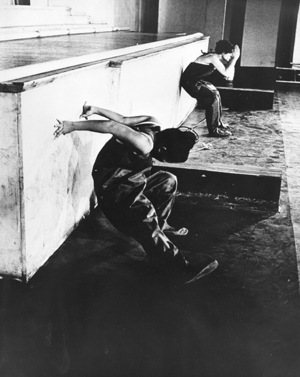
She went to New York, at the invitation of Martha Graham, and started performing her own works, including at the Judson Dance Theater, in experimental collaborations with Blank.
Their creation made for a stunningly unique statement, rooted in classical Kabuki dance that is abstracted and linked in approach, form and idea to American modern dance _ in the same way other forms of the Japanese art, craftsmanship and design, exemplified in pottery, woodblock prints, Noh music and rock gardens, have a definitive conceptual affinity to modern art.
Some of Blank and Hanayagi’s works _ as playful as they were at times political, but always unafraid, everyday yet unabashedly personal _ were recreated in “KOOL,” along with photos and video of Hanayagi, in past works and in recent years, ill with Alzheimer’s in an Osaka instition.
The most tragic thing about Suzushi’s remarkable life is that she is all but forgotten as a pioneer artist in her home country, especially when women of her generation are finally starting to win the recognition and respect they so deserve as inspiring role models for this nation’s still under-utilized but multi-talented women.
Now, Japan will have an opporutnity to learn more about Suzushi Hanayagi and her artistic vision in a documentary film, directed by Richard Rutkowski and produced by Hisami Kuroiwa, “The Space in Back of You,” in which Blank as well as Wilson, David Byrne and Anna Halprin also appear.
The film is being shown at Theater Image Forum in Shibuya, Tokyo, SAT Sept. 29, 2012, 9 p.m. and SAT Oct. 9, 2012, 9 p.m. as part of the Dance Triennale Tokyo festival.
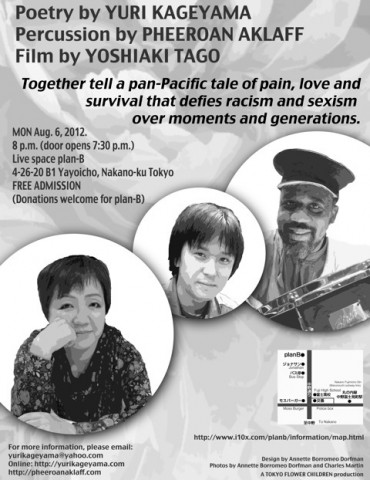

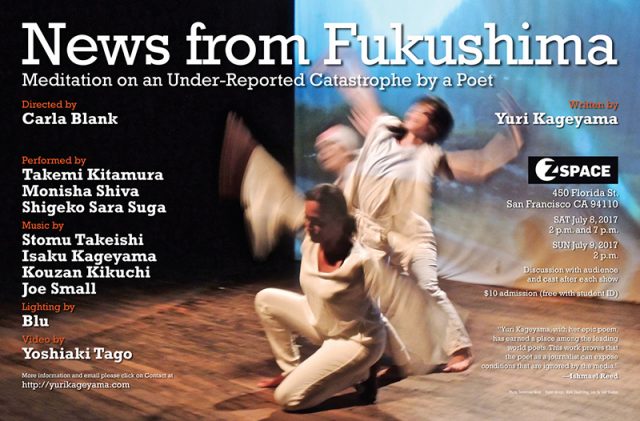
Poet Yuri Kageyama, Drummer Pheeroan akLaff and Filmmaker Yoshiaki Tago

YURI KAGEYAMA, a poet of both worlds Japan and America, American drummer PHEEROAN AKLAFF and Japanese filmmaker YOSHIAKI TAGO come together to tell a pan-Pacific tale of pain, love and survival that defies racism and sexism over moments and generations.

Witness, celebrate and join in this exhilarating crossing of barriers of cultures and genres to debunk stereotypes and find free expression.

MON Aug. 6, 2012. 8 p.m. (door opens 7:30 p.m.)
at Live space plan-B (4-26-20 B1 Yayoicho Nakano-ku, TOKYO.
FREE ADMISSION (Donations welcome for plan-B).

Yuri Kageyama is the author of “The New and Selected Yuri: Writing From Peeling Till Now.” Her works, winning praise from literary giants like Ishmael Reed and Shuntaro Tanikawa, appear in “Y’Bird,” “Pow Wow,” “Breaking Silence,” “On a Bed of Rice,” “Konch” and “Phati’tude.” She has read with Eric Kamau Gravatt, Isaku Kageyama, Ashwut Rodriguez, Seamus Heaney, Shozu Ben, Victor Hernandez Cruz and the Broun Fellinis.
http://yurikageyama.com

Pheeroan AkLaff is a New York-based drummer and composer. He has played with Rashied Ali, Oliver Lake, Henry Threadgill, Cecil Taylor, Yosuke Yamashita and Andrew Hill. A headliner at many festivals including Moers and Nurnberg, he is in Japan on the “Dear Freedom Suite” tour with Jun Miyake and Toshiki Nagata. He has led an ensemble dedicated to John Coltrane’s music. He teaches at Wesleyan University.
http://pheeroanaklaff.com

Yoshiaki Tago directed “Worst Contact,” “Believer” and “Maid in Akihabara,” and served as assistant director on many Japanese feature films. A graduate of the prestigious Japan Academy of Moving Images, Tago frequently works on TV shows and promotional videos for pop artists, major companies and government projects. He is documenting Kageyama’s readings with music in a work-in-progress “Talking TAIKO.”

For more information, email yurikageyama@yahoo.com or 090-4594-2911

A TOKYO FLOWER CHILDREN production

Rise of the Yuricane _ Spotlight on Jazz and Poetry

We are a mom and son team _ musician Isaku Kageyama and poet Yuri Kageyama. And we were featured in this delightful and tasteful show called “Spotlight on Jazz and Poetry,” hosted by Mr. Clay Corley, Sr., who lives in Philadelphia, and is a poet and writer himself. He’s putting us in great company. Among those he has featured on his show are Ornette Coleman, Sonya Sanchez, Quincy Jones, Amiri Baraka.
It was a true discovery to experience my work in a show like this, especially juxtaposed with Isaku’s music. I thought I was so familiar with all the material. But everything felt so fresh, seeing one’s own work through someone else’s perspective.
Please click HERE to hear how Clayton has put together our poetry and music, and HERE for the conversational interview by Clayton and his poet partner Donna Kirven, about our backgrounds, feelings, lives and intentions of our art.
One question I was asked was: If I were to describe my work as a kind of food, what would that be?
So I said, “Water,” something that is everyday but essential, shining in the light into whatever color, tasteless, but becoming part of our bodies.
And Donna said that was a very unusual answer, and she liked it.
Later, I happened to look on Isaku’s blog and I saw he was likening his taiko playing to mineral water. So I guess we are a mom and son team.
Thanks for having us on the show: www.sojpradio.com And thanks for supporting our work.

an ode to Facebook upon its IPO _ a Poem by Yuri Kageyama

an ode to Facebook upon its IPO
a Poem by Yuri Kageyama

For moms, Facebook is priceless. How else are we going to find out what our kid away at college is up to? LOL. Pore over his posts, his comments on communities. Send friend requests to his friends, friends of his friends, even moms of his friends. LOL. Some moms have kids who ignore moms’ friend requests, and so they can look only at their public posts. No fun. My son is a musician so all his posts are public so a lot for me to read. Oh, good. He has a gig with another student. Oh, good. He is smiling in a photo he is tagged in. He has linked to a YouTube video of his performance at school. He is out jogging with his roommate. Fun. He has posted a quote by one of his teachers. Maybe he is learning something. Uh-oh. He is angry musicians have a hard time getting paid. He feels he can’t eat shrimp today. Maybe I should send him a check. He deserves to eat shrimp once in a while. Oh, great. He is writing out the score to a Kabuki dance piece, one of my favorites. Maybe he is learning something. He is quoting Ryunosuke Akutagawa. Maybe he is really learning something. But wait. The comment is about suicide. OMG. Is he depressed? Uh-oh. One of his friends at the same music school, who is now my friend, also has a horribly depressing post. Another says she wakes up petrified of her dreams. What’s going on? Was I like this when I was at college? Oh, right. People would be jumping over the gorge every week at Cornell. Oh, no. Maybe he is learning too much. I leave a comment for the friend with the scary dreams that dreams are ways to cope with reality, and she should just tell herself dreams are just dreams. Thank you, friends. They are telling him about teaching positions, to not worry too much about jobs while at school and are giving friendly advice, cheering him up. Maybe he feels better. Oh, good. He is back to posting an analysis about a musician’s sound. Oh, wow. I am so moved I may cry. He is now friends with his former girlfriend, the one who plays the violin, the one I thought would never forgive him, the one he broke up with after an abortion.

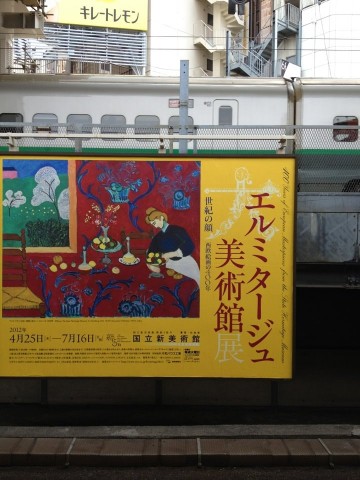
Haiku for Matisse by Yuri Kageyama

Haiku for Matisse
by Yuri Kageyama

Red over green
You got that right, Matisse
Then, Today and Forever.

And the Japanese translation
by Yuri Kageyama

俳句フォーマチス

グリーンよりあか
そのときもいまも
せいかい

Isaku Kageyama represents Japan at Berklee College of Music

Isaku Kageyama represents Japan at the Berklee College of Music with Ayumi Ueda and Suyama Jackson.

Denouement _ a poem by Yuri Kageyama

Denouement
a Poem by Yuri Kageyama

You are curled up, tight, still, in fetal position, eyes closed but seeing red blindness, throbbing flesh, deep inside our stomachs, so entrenched within, but disjointed, expanding _ like our pain, infinite like solar systems in the universe.
I was already there in that moment.
We shared in that secret of knowing, knowing you will be born, someday, before anyone else knew, and then grow up and become man _ or woman _ with a yelping gasping flash-of-light wail, the newborn’s cry in that first breath, and recognizing from the very start that you will, someday, have this same joy and same pain, growing inside you and being born.
It doesn’t matter you will make towers. You will make music. You will make computer programs. You will make money. You will make babies.
It doesn’t matter you will be a pillar of society. You will be an outcast. You will win rewards. You will be abused as a stranger.
It doesn’t matter you will witness a great northern earthquake, although it is a once-in-a-century disaster setting off a torrent of outraged water that turns farmland into mud, buildings and homes into rubble, and quiet untouched happy towns into ghost towns, untouched but covered with radiation.
I was there, with you, before it all _ in that redness and blackness and all seeing blindness, that was here and everywhere, bleeding and beating and breathing and being, inside my uterus, that spot near my navel that connects with your navel, before and even after your terrified newborn cry.
This is the same cosmos inside the bodies of all mothers, where we fall in our slumber, snuggling against our blankets, the safe and eternal place we visit that are called dreams after we awaken.
This is the same cosmos gyrating in the resonance of the giant taiko drum, shaking and deafening that we hear and understand every note like our mother’s heartbeat.
The otherworldly world that awaits behind the mirror in a Tadanori Yokoo painting, the crooked road not taken behind that church in a Vincent Van Gogh painting _ a world from this end we fear might be the Michelangelo hell of a nuclear meltdown with faces and arms peeled, stunted and contaminated by an erring god scientists will never admit was provoked by anything other than a mother’s mistake, or else it could smell like lotuses and incense and honeyed candles, sinking into a Claude Monet lake of sheer light and blindness that is canvas and museum walls no more but total artist’s vision.
This is the same cosmos where ghosts with long black hair reside, sometimes standing besides riverside willow trees weeping about betrayal, while at other times mysteriously saving children from car crashes as benevolent all-knowing ancestors.
After all these years, I finally know this is where I return when I die.
To be with you again, all the time, in that moment of eternity that is before birth, so perfectly connected we don’t need to speak or breathe or remember.

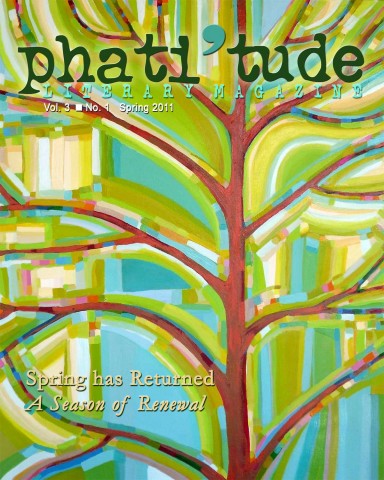
My poem in a literary magazine

Just got this publication “phati’tude” Literary Magazine. It has my poem:

For women only

perfume,
rubbing shoulders,
we rattle silently over the tracks
blouses, tucked bags, even powdered chins,
up too close to really see;
we sense only relief
we smell no greasy beards or sweaty suits or
beer breath of the morning after _
this morning commuter train
“josei senyo sha”
reserved
for women only,
introduced to protect the gentle sex
from those groping dark hands
preying prying fingers, stroking thigh,
poking panties,
pretending to be penises
right in public transport,
“josei senyo sha”
this is the kindness of Japanese society:
let chikan go unchecked,
forgiven for their mischief,
and give us, women, this special spot
farthest from the action
farthest from the ticket gates
the first car up front,
and the most dangerous
if we crash

No April Fool’s Joke: at the Bowery Poetry Club in NY

ISHMAEL REED PUBLISHING COMPANY PRESENTS A BOOK PARTY for
“The New and Selected Yuri,” poetry and stories by YURI KAGEYAMA:

Bowery Poetry Club 308 Bowery (between Houston and Bleecker) New York City
Sunday, April 1, 2012 8 p.m.

Special Guests ISHMAEL REED and TENNESSEE REED.
A reading-performance of “STORY OF MIU,” written by Yuri Kageyama, directed by CARLA BLANK, featuring dancer YUKI KAWAHISA, with music by PHEEROAN AKLAFF, in a collage of words, sound and movement, a pan-Pacific tale of pain, love and survival that defies racism and sexism over moments and generations.

Ishmael Reed is the author of “Mumbo Jumbo,” “Juice,” “The Last Days of Louisiana Red,” “Japanese by Spring,” “Yellow Back Radio Broke-Down” and some 20 other books. He is a poet, publisher, satirist, playwright, pianist, TV producer and songwriter. He taught at the University of California Berkeley for more than 30 years. He founded the Before Columbus Foundation.

Carla Blank has been a performer, director, dramaturge and teacher of dance and theater for more than 40 years. Recently, she worked with Robert Wilson on “KOOL – Dancing in My Mind” inspired by Japanese choreographer Suzushi Hanayagi, a longtime collaborator. Since 2003 she has been dramaturge and director of the two-act play “The Domestic Crusaders” by Wajahat Ali. She has taught at the University of California Berkeley, Dartmouth College and the University of Washington.

Yuki Kawahisa, a native of Japan, is an actor and performance artist. Based in New York, Kawahisa has been performing her own works and others’ works internationally, including Canada, France, Germany, Austria, Japan, Indonesia and Australia. She has worked with internationally acclaimed theater directors Robert Wilson and Richard Forman, as well as with dancers, media artists, painters, vocal artists and musicians.

Pheeroan AkLaff
is a New York-based drummer and composer, who has played with Oliver Lake, Anthony Davis, Henry Threadgill, Cecil Taylor, Yosuke Yamashita and Andrew Hill. He was a headliner at many festivals including Moers and Nurnberg. He led the Double Duo ensemble dedicated to the spiritual music of John Coltrane. He teaches at Wesleyan University.

Tennessee Reed is the author of five poetry collections and a memoir. She has read in the U.S., the Netherlands, Germany and Japan. Her sixth poetry collection “New and Selected Poetry 1982-2010” will be published by World Parade this year. She is managing editor of Konch Magazine. She has a B.A. from UC Berkeley, and an M.F.A. from Mills College.

Yuri Kageyama’s poetry, short stories and essays have been published in “Y’Bird,” “Pow Wow,” “Breaking Silence” “On a Bed of Rice,” Konch and “Pirene’s Fountain.” She reads with her band Yuricane, featuring Eric Kamau Gravatt, Isaku Kageyama, Winchester Nii Tete and other multicultural musicians. Japanese director Yoshiako Tago is documenting her readings on film, “Talking TAIKO.”

The Poetics of Being

The Poetics of Being
by Yuri Kageyama

When my first poem to be ever published, “The Big White Bitch,” appeared in Ishmael Reed and Al Young’s iconic “Y’Bird” 30 years ago, Geraldine Kudaka sighed, sympathy clear in her eyes, and remarked I was making a tough debut in the literary world as a “Third World feminist poet.”
I didn’t fully understand or maybe even care what that meant. And I probably still don’t.
I have never been much of a marketer.
If we believe in our work, as we certainly do, we must get the word out and get people to read what we have to say.
But for me, writing is a solitary act, a conversation with something absolute and eternal that is everywhere in everyday life, yet beyond everyday life.
I don’t write to please an audience, connect to a sociological category or further a political movement.
And so my poetry has basically not changed.
If the poetry I do, which may be what some call Third World feminist, is growing more readily accepted in the world today, perhaps because of advances we have made in diversity and sexual equality, that is as irrelevant to what I do as it was 30 years ago when I was writing in a room of my own, shouting in the wilderness, a shaman without a single listener.
That is because writing is solitary act, unaffected by how audiences may have changed.
That is not to say that the search for sexual and racial equality is irrelevant.
It is as relevant and pressing as ever.
There is sociological evidence that show how women of color today remain in some ways as underrepresented, stereotyped and powerless as they were in the 1970s.
The themes in my writing, which address how racism and sexism shape our relationships and our psyches, are not going to change like seasonal fashion plates, technological platform innovations or topical headlines.
The themes are too eternal, too universal, too real _ the pain the child feels when he or she is called “Jap,” the shock of realizing as a teen mainstream beauty standards mean the ugliest white person is going to “win” over the coolest-looking non-white person, the horror of knowing that around the world people are seeing their children starve, undergoing genital mutilation and risking their lives just to win the right to vote.
As poets and storytellers, we can only start _ right here _ with what we know, what we have seen, what is in our hearts, who we are, and no one can help us.
Writing is a solitary act.
We must be honest in a world full of lies, we must be fearless as we tremble in fear, and we must speak with our own voice, alone, and never try to please.
Last year, I got a new book out, “The New and Selected Yuri _ Writing From Peeling Till Now,” which compiles my poetry, stories and essays from the 1970s to today.
It, too, is published by Ishmael Reed, who put out my first book of poems, “Peeling” in 1988 _ as well as my first poem ever to be published, “Big White Bitch.”
The latest book includes a companion piece to that poem, “Little YELLOW Slut,” which runs down the stereotypes of the Asian female.
The imagery, this time, has taken a global turn, born in Hollywood and American pop but thriving, never lost in translation, in Tokyo, and vice versa.
I am proud of this poem and this book.
I am proud that someone like Ishmael Reed has believed in me and my work for more than 30 years.
I know nothing will ever stop me from writing more poems like these.
And I still have so many stories to tell.
I don’t feel I am returning to explore old themes.
I don’t feel I am trying to break new ground.
I am just writing.
The search for identity, love and erotica is as timeless as is my wish for racism and sexism to disappear from the face of this planet, no longer so urgent, so violent, so degrading.
Writing is a solitary act.
Gertrude Stein in “The Autobiography of Alice B. Toklas” talks about giving a lecture in Oxford, and how she answered questions about knowing “she was right in doing the kind of writing she did.”
“She answered that it was not a question of what any one thought, but after all she had been doing as she did for about 20 years,” she wrote.
“This did not mean of course that they were coming to think that her way was a possible way, it proved nothing, but on the other hand it did possibly indicate something.”