Japanophile Part 2 A Story by Yuri Kageyama

The toys piled up, evidence being submitted to prove an absent mother’s love.
The colorful trading cards were those warm hugs that were never given, the video-game cassettes in the dozens were those sleepless feverish nights forgotten, and the tiny cars that scuttled across the linoleum threatening to trip adult feet were those lullabies that fell silent. I wanted to prove I loved my toddler son, still too young to understand that I needed those hours away to pay the rent.
“When are you going to quit your job?” he would ask now and then, choosing a quiet moment he knows will get my full attention.
This is a serious question to be contended with. I want to cry. I would quit right now, if I could. But I don’t know how to tell him that.
His legs are starting to break out in hives, and because he scratches at his raw skin with his little clawlike nails, his calves are constantly bleeding.
Once I got a call from the social welfare office, wondering what’s going on. The doctor that I take him to for these allergies, as that’s what it is that is causing this itching, is giving me funny stares.
“My mommy doesn’t come home for a loooooong loooooong time,” I hear my son telling the doctor in his usual high-pitched singsong voice.
I was able to take some time off work the first few years after his birth. I dutifully followed the advice of La Leche League to breast-feed him as long as he wanted, or almost as long as he wanted, which turned out to be two years, after which I had to decide this was it.
He would cuddle next to my breast, sucking although he had grown to be more a little boy than a baby, staring into my eyes with total trust and the glee of possession, sometimes biting my nipple with his teeth or pulling with clamped lips until I had to ask him to stop. His looks said he was proud to have this privilege, especially because he no longer needed the nourishment.
A woman who happened to walk by remarked, “Oh, you are not working? So he doesn’t know the reality that is waiting for him; does he?”
I clearly remember the I-know-it-all expression of superiority on her face as though she had appointed herself a shaman fortune-teller, as do all those working women who went before me.
At least, they get to do that _ tell others what’s coming.
Even after my son started school, he didn’t really have a mother. I found out his friends were asking him: “Do you have a mother?”
It was a cruel, brutally straightforward question that children have a way of coming up with, but it was a valid question.
If others had moms picking them up and making nice lunches, and he didn’t, where was this mother?
Where was I for this child? Did this make me really a mother? Did I just want a child so I could have a child but without doing the job of being a mother?
I had to wipe the thought out of my mind when I was working. I had to forget.
Forgetting, you’d think, is something that happens naturally, what you thought you had tucked away in memory, some fold in your gray matter, slipping away. Oh, I forgot. But this was a different kind of forgetting.
It took a lot of concentration. But I was able to forget. If I did not forget, I would have lost my mind.
But I did forget.
But was this child able to forget?
Or did he have to fight the gnawing loneliness with all his might, fighting back tears and telling himself: “My mommy doesn’t come home for a loooooong loooooong time,” over and over?
It makes me afraid.
I cannot imagine such loneliness. To be a child and not have a mother. To be that tiny dot in the sky like a star all by itself in the universe and not know what is up or down, or if and when this horror will ever end.
To know not only that you are alone but that you are alone in this loneliness, that every other boy and girl had a mommy, that soft warm cuddly woman who came to pick kids up and made nicely decorated lunches.
How could a little mind forget? Even with all the colorful cards, games and tiny cars, reminding you that I do love you, how could he ever forget?
In his high school, there was one day hot lunch was not served, some strange practice to encourage parent-child bonding. My son didn’t even tell me.
I happened to see him jump into a convenience store to buy his lunch. That’s how I found out.
I felt a hot gush of guilt and sorrow as though it was enveloping me from the top of my head, the strange feeling I felt when I watched my father eat or my sister cry over nothing, when I was growing up.
I still have not figured out what this emotion meant. It tasted sour, like tiny pieces of glass, inside my mouth.

No April Fool’s Joke: at the Bowery Poetry Club in NY

ISHMAEL REED PUBLISHING COMPANY PRESENTS A BOOK PARTY for
“The New and Selected Yuri,” poetry and stories by YURI KAGEYAMA:

Bowery Poetry Club 308 Bowery (between Houston and Bleecker) New York City
Sunday, April 1, 2012 8 p.m.

Special Guests ISHMAEL REED and TENNESSEE REED.
A reading-performance of “STORY OF MIU,” written by Yuri Kageyama, directed by CARLA BLANK, featuring dancer YUKI KAWAHISA, with music by PHEEROAN AKLAFF, in a collage of words, sound and movement, a pan-Pacific tale of pain, love and survival that defies racism and sexism over moments and generations.

Ishmael Reed is the author of “Mumbo Jumbo,” “Juice,” “The Last Days of Louisiana Red,” “Japanese by Spring,” “Yellow Back Radio Broke-Down” and some 20 other books. He is a poet, publisher, satirist, playwright, pianist, TV producer and songwriter. He taught at the University of California Berkeley for more than 30 years. He founded the Before Columbus Foundation.

Carla Blank has been a performer, director, dramaturge and teacher of dance and theater for more than 40 years. Recently, she worked with Robert Wilson on “KOOL – Dancing in My Mind” inspired by Japanese choreographer Suzushi Hanayagi, a longtime collaborator. Since 2003 she has been dramaturge and director of the two-act play “The Domestic Crusaders” by Wajahat Ali. She has taught at the University of California Berkeley, Dartmouth College and the University of Washington.

Yuki Kawahisa, a native of Japan, is an actor and performance artist. Based in New York, Kawahisa has been performing her own works and others’ works internationally, including Canada, France, Germany, Austria, Japan, Indonesia and Australia. She has worked with internationally acclaimed theater directors Robert Wilson and Richard Forman, as well as with dancers, media artists, painters, vocal artists and musicians.

Pheeroan AkLaff
is a New York-based drummer and composer, who has played with Oliver Lake, Anthony Davis, Henry Threadgill, Cecil Taylor, Yosuke Yamashita and Andrew Hill. He was a headliner at many festivals including Moers and Nurnberg. He led the Double Duo ensemble dedicated to the spiritual music of John Coltrane. He teaches at Wesleyan University.

Tennessee Reed is the author of five poetry collections and a memoir. She has read in the U.S., the Netherlands, Germany and Japan. Her sixth poetry collection “New and Selected Poetry 1982-2010” will be published by World Parade this year. She is managing editor of Konch Magazine. She has a B.A. from UC Berkeley, and an M.F.A. from Mills College.

Yuri Kageyama’s poetry, short stories and essays have been published in “Y’Bird,” “Pow Wow,” “Breaking Silence” “On a Bed of Rice,” Konch and “Pirene’s Fountain.” She reads with her band Yuricane, featuring Eric Kamau Gravatt, Isaku Kageyama, Winchester Nii Tete and other multicultural musicians. Japanese director Yoshiako Tago is documenting her readings on film, “Talking TAIKO.”

My Poetry in Pirene’s Fountain

My two poems “Haiku for Van Gogh” and “how to say ‘yes’ in Japanese” (coincidentally read in Tokyo recently) are published in Pirene’s Fountain.
The bio and poetry from inside the pages of the latest issue:
Yuri Kageyama is a poet and writer of bilingual and bicultural upbringing, born in Japan and growing up in Maryland, Tokyo and Alabama. She has two books, “The New and Selected Yuri: Writing From Peeling Till Now” (Ishmael Reed Publishing Co.) and “Peeling” (I. Reed Books). Her works appear in many literary anthologies and magazines, including “Y’Bird,” “Greenfield Review,” “San Francisco Stories,” “On a Bed of Rice,” “Breaking Silence: an Anthology of Asian American Poets,” “POW WOW: Charting the Fault Lines in the American Experience _ Short Fiction from Then to Now,” “Other Side River,” “Beyond Rice,” “Yellow Silk,” “Stories We Hold Secret,” “KONCH” and “MultiAmerica.” She has read with Ishmael Reed, Shuntaro Tanikawa, Eric Kamau Gravatt, Geraldine Kudaka, Victor Hernandez Cruz, Winchester Nii Tete, Seamus Heaney, Takenari Shibata, Shozu Ben and many other artists. She is a magna cum laude graduate of Cornell University and holds an M.A. from the University of California, Berkeley. She is working on an oral history of Tokyo taiko drumming group Amanojaku, where her son Isaku Kageyama is a principal drummer. yurikageyama.com

Haiku for Van Gogh | ways of saying ‘yes’ in Japanese

Haiku for Van Gogh

An old wooden desk
Yellow dots of light shrieking
Van Gogh’s room

Warped plums dagger rain
Crazed geisha dance in ukiyoe oil
Breathe Van Gogh’s Japan

Sliced ear of love denied
Road to nothing ravens in flight
Genius of yellow

ways of saying ‘yes’ in Japanese

“Hai!!”
That’s the correct way of replying when spoken to in Japan for centuries, hai! the way people are taught in school, by their parents, what’s right in society _
respect for the hierarchy, yes sir, thank you ma’am, hai hai hai, like hiccups, like hiphiphurray, hai! hai! hai! no pause, no hesitation, no thought,
following orders, quick, no questions, grunt it out, soldiers at attention, yelling, spitting, believing, say it with all your heart and mind,
hai!

“Haa~aai!”
That’s the way people answer in Japan these says, haa~aai! the way people drop out of school, freeters, parents are just friends to follow only on Twitter _
flattening out the hierarchy, maybe yes, maybe not, haa~aai! like a mumble, like a whisper, a kiss on the ear, haa~aai, innocent, hurt only for others,
wind blowing in your hair, smiley faces heart icons in cell phones, improvise, imagine, immaculate, sing it without a care in the world,
haa~aai!

Nothing quite like the literary San Francisco crowd


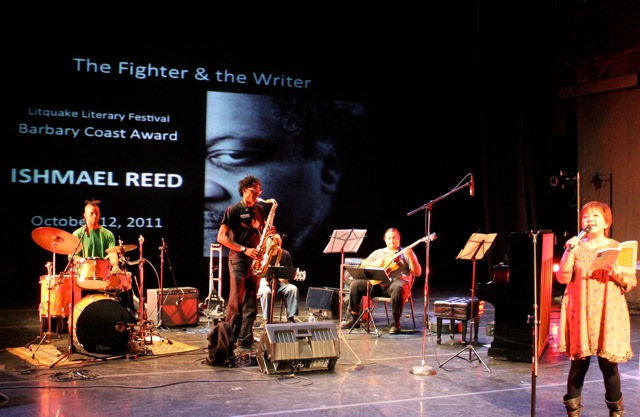
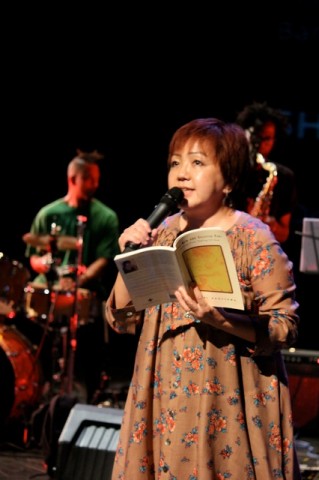
Reading by Yuri Kageyama of “Little YELLOW Slut” with the Broun Fellinis at Z Space in San Francisco, where Ishmael Reed received the Barbary Coast Award Oct. 12, 2011. Video by Annette Borromeo Dorfman.

Little YELLOW Slut
Poetry by Yuri Kageyama
first published in KONCH MAGAZINE, 2009.

You know her:
That Little YELLOW Slut, proudly gleefully
YELLOW-ly hanging on Big Master’s arm,
War bride, geisha,
GI’s home away from home,
Whore for last samurai,
Hula dancer with seaweed hair,
Yoko Ohno,
Akihabara cafe maid,
Hi-Hi Puffy Ami/Yumi,
Kawaiiii like keitai,
Back-up dancer for Gwen Stefani,
Your real-life Second Life avatar
Eager to deliver your freakiest fetish fantasies,
Disco queen, skirt up the crotch,
Fish-net stockings, bow-legged, anorexic, raisin nipples, tip-toeing Roppongi on
Stiletto heels.

Yessu, i spikku ingrishhu, i raikku gaijeeen, they kiss you,
hold your hand, open doors for me,
open legs for you, giggling pidgin, covering mouth,
so happy to be
Little YELLOW Slut.

Everybody’s seen her:
That Little YELLOW Slut, waiting at
Home, cooking rice, the Japanese
Condoleezza Rice,
Smelling of sushi,
Breath and vagina,
Fish and vinegar,
Fermented rice,
Honored to be
Cleaning lady,
Flight attendant for Singapore Airlines,
Charlie Chan’s Angel,
Nurse maid, gardener, Japan-expert’s wife,
Mochi manga face,
Yodeling minyo, growling enka,
Sex toy, slant-eyes closed, licking, tasting, swallowing STD semen,
Every drop.

Yessu, i wanna baby who looohkuh gaijeen, double-fold eye, translucent skin, international school PTA,
maybe grow up to be fashion model, even joshi-ana,
not-not-not happy to be
Little YELLOW Slut.

I recognize her:
That Little YELLOW Slut, rejecting
Japanese, rejected by Japanese,
Ashamed,
Empty inside,
They all look alike,
Faceless, hoping to forget, escape
To America,
Slant-eyed clitoris,
Adopted orphan,
Dream come true for pedophiles,
Serving sake, pouring tea, spilling honey,
Naturalized citizen,
Buying Gucci,
Docile doll,
Rag-doll, Miss Universe, manic harakiri depressive, rape victim, she is
You, she is me.

Hai, hai, eigo wakarimasen, worship Big Master for mind, matter, muscle, money, body size correlates to penis size,
waiting to be sexually harassed, so sorry, so many,
so sad to be
Little YELLOW Slut.

Another review of “The New and Selected Yuri”

A review by poet Ravi Chandra’s of my latest book, “The New and Selected Yuri: Writing From Peeling Till Now,” (Ishmael Reed Publishing Co., 2011.)

I met Yuri Kageyama at an event honoring Ishmael Reed at LitQuake. Yuri performed her piece “Little YELLOW Slut”, a powerful spoken word piece that punctuates stereotypes of Asian American women with the judgmental projection “Little YELLOW SluT.”

I was immediately taken by this piece, and was proud to soon be carrying Kageyama’s latest collection of work, which she generously gifted me in exchange for my modest first book, “a fox peeks out: poems.”

I was very impressed by Kageyama’s poetry and prose, which are both a tender and raw depiction of her Asian American sexuality and political mindset.

Some of the poems are in what’s now called the “wordfist” tradition, like “BIG WHITE BITCH,” taking aim at and taking down the oppressive forces of racism and sexism with a uniquely feminine yet tough-spoken mindset.

These are angry and direct. Some might find them shocking, but I found them vivid and real.

Others are a lament _ of childhood abuse by her rocket scientist father and of sitting next to him as he lay dying.

There are also many prose pieces. One discusses Japanese concepts such as Kakijun, Enryo and Iki. Another is a perhaps semi-autobiographical look back at 1970’s political-poetic movements in San Francisco.

Another is a dialogue between her and a younger Asian American woman living in Japan and struggling for relationship and power _ possibly a younger version of herself.

This is an emininently readable and enjoyable collection.

I found myself in turns challenged and entertained by the sheer soul-force of the person who comes shining through these words. Close to the heart, close to the soul, deeply human and remarkable. Recommended.

^___< And here is my review, in turn, of Chandra’s book:

A lot of poetry, probably including much of my own, is destructive, addressing inner turmoils to give them a form of expression as literature than other equally tempting but less acceptable, perhaps even criminal, outlets.
Such is the madness of the world around us, the abuse that we take and the psychosis we battle by the day.
Ravi Chandra’s poetry is the voice of calm, the antidote of therapy, the ointment of peace.
Perhaps it is because he is a medical doctor and psychiatrist that he seeks to heal not only internal wounds but almost the entire world around us with his debut poetry book “a fox peeks out _ poems.” (San Francisco: Pacific Heart Books, 2011)
He juxtaposes the technology of the Internet with the tradition of Asian religions in the same poetic breath that is our American experience.
Other types of slam poetry may be identified with street violence and the defiance of oppression.
Chandra’s slam poetry is more like the chamomile tea you sip before bedtime.
His works read almost like a prayer, asking God to keep us safe through another day:
“Heart like earth _ /Mind like sky./ No walls, no weapons, no war/”
The power to soothe and unify through the word involves a risky balance to keep between artistry and platitude.
Chandra pulls it off with the intelligence of a scholar, the insight of a master and, most important, the benevolence of a saint.
“Mountains do get built from earthquakes,/ great masses of earth pushing into each other,/ Pushing the ground up,” he writes in “subprime tsunamis.”
“Greed must be contained by wisdom./ Compassion must be the greatest power./ Only so, can the waters purify./ Only so, can earthquakes/ give ascent,/ instead of annihilation.”

Little YELLOW Slut

Some people, when I ask them to sing along to my poem, don’t want to utter the dreaded words: “Little YELLOW Slut.” Good people don’t want to repeat derogatory phrases. But it’s OK. This is a Poem: saying it will make discrimination, racists and sexists, all evil thoughts go away _ like “oharai” by the shaman.

2011 Barbary Coast Award literary event in San Francisco


(photos by Annette Dorfman)

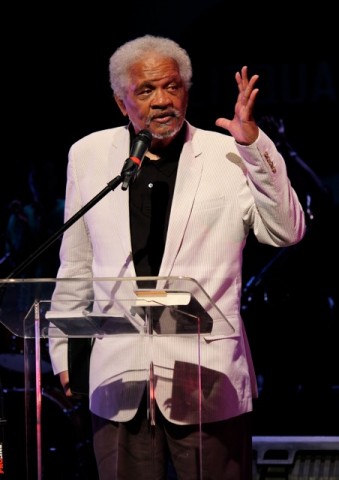
I was in San Francisco Oct. 12, 2011 for the 2011 Barbary Coast Award given to my mentor and publisher and great poet, novelist and teacher Ishmael Reed. Reed is the author of at least 27 books, including Mumbo Jumbo, The Last Days of Louisiana Red and Yellow Back Radio Broke-Down. He is also a publisher (as I well know), television producer, songwriter, pianist and radio and television commentator. He taught at the University of California, Berkeley, for 30 years.
I just finished his latest novel “Juice!” which highlights his talent as a visual artist/cartoonist as well. The book is not only a deliciously hilarious read, offering insightful satire on U.S. race relations and celebrity scandals, it is also a profound testament, even tribute, to what could now be a passing glory era of the mainstream media _ in all its grandeur, ludicrousness, power and human potential.

More from the ceremony below: Photos and video clips of performances, including my reading with music.

Congratulations to Ishmael Reed

(video by Evan Karp)
Ishmael Reed, who published my latest book “The New and Selected Yuri: Writing From Peeling Till Now,” received the Barbary Coast Award WED Oct. 12, 2011, at a gala ceremony at Z Space in San Francisco, a program packed with poets, musicians and performers, includng even me, who read “Litte YELLOW Slut” with the Broun Fellinis _ from left to right Kirk Peterson (bass), Kevin Carnas (drums), David Boyce (saxophone) _ Makoto Horiuchi (guitar), Ashwut Rodriguez (guitar) and the great Ishmael Reed (piano).

More photos by Annette Dorfman at Litquake:

who is the poet? a poem by Yuri Kageyama

who is the poet?
a poem by Yuri Kageyama

poets who pause to pontificate
poets who write for grants
poets who count syllables
poets who admire texture of words
i work and have no time
and i have no time for
poets who have all the time
poets who find poetic moments
poets who teach laureate poetry
poets who chatter on Facebook
it is blood in the veins
to kill and give birth and die
i am the true poet, not you
poets of the revolution
poets weeping tears at bars
poets who don’t write lyrics
poets of pure soundless music
angels of suicide
bridge of neon, cliff of ice
we are the true poets, not you