Why the Japanese Love Michael Jackson, an essay by Yuri Kageyama

Why the Japanese Love Michael Jackson
By YURI KAGEYAMA

“MY-keh-rooh,” as Japanese fans adoringly call him, never had to worry about being perceived a wacko-weirdo here _ a culture where neoteny, or the celebration of juvenile traits, and the cross-gender persona, as in effeminate men and masculine women, are at the core of this nation’s highest art forms.
Japanese are used to seeing in its top artists the very traits that some Westerners found so creepy and appalling in Michael Jackson.
It’s not surprising Japanese, long known for their worship of American musicians and movie stars, came out screaming and cheering at sell-out stadiums during Jackson’s “Thriller”-day heights of the 1980s.
But Japanese came out screaming and cheering even in recent years when Jackson was in Tokyo for shopping sprees at gadget stores, visits to Disneyland and Joypolis, an amusement park run by game-maker Sega, and tightly orchestrated events for fans, where he didn’t sing a single note or glide a single Moon-walk.
He was MY-keh-rooh, the gloved man-child, sweet, innocent, pure _ and oh, so “kawaii.”
Kawaii literally translates as “cute.” But the Japanese has none of the connotations of sexuality associated with the word in the West.
An old man, a subcompact car, something as innocuous as an umbrella, digital camera or kitchen utensil, even something grotesque like a horror-film creature can be potentially kawaii.
Kawaii is about the emotion evoked by a child from its parent, and so is linked in the Japanese mind with the most basic and honorable instinct for the preservation of the species.
It is about love. And it is virtuous.
Kawaii-ness is the keystone of artistic sensibilities from as far back as the Edo Period, prevalent in Hokusai woodblock prints. It is very much alive today in “manga” comics filled with doe-eyed heroes, as well as in the Mickey-Mouse parody sculptures and drawings of Takashi Murakami.
By Western standards, kawaii is embarrassingly frivolous _ like an adult being caught clutching a stuffed animal.
But it’s taken very seriously in Japanese art.
So the King of Pop cavorting on amusement-park rides, cuddling Bubbles the chimp, collecting dolls and playing with children are far more easily accepted as normal adult behavior in Japanese culture.
It is aesthetically almost a modern-day “Tale of Genji,” a floating-world quest for the essence of beauty in a child.
Fans worshiped Jackson not only for his obviously dazzling singing and dancing talents.
As neoteny believers, they were able to take at face value without the cynical doubts, more typical of the Western intelligentsia, his “We Are the World” messages on peace and spirituality.
Jackson could do no wrong as a kawaii guy with his soft velvety voice and shy quiet mannerisms, even as his nose changed sizes and his skin changed tones, no matter.
Take any Japanese MJ fan. Ask him or her whether Jackson is kawaii. And the answer would be a definitive “Yes.”
Jackson was a genius at perpetually staying the child. Even in his final photos, he looks pretty kawaii, especially for a man in his 50s.
Jackson was a master at blurring social barriers, and his denials of such definitions went beyond just age: Black, he looks white. Male, he looks so pretty he is asexual.
That is another reason why Jackson has endeared himself to the Japanese psyche.
A womanly male is about as high as one can get in the pinnacle of Japanese art, as evident in the world of Kabuki, where all roles, including those of women, are played by men.
As a counterpoint to this male-oriented theater is the world of Takarazuka, where all roles, including those of men, are played by women.
Japan is still such a sexually divided society, despite the recent advancement of women, people enjoy the escape that art offers in seeing categorizations turned upside down.
Perhaps it can be said that social definitions are so rigid in the mainstream an artist, by definition, is expected to defy them.
In Kabuki, the denials of convention extend to age. An 80-year-old master routinely plays a teen-age village damsel, and a proper Japanese won’t blink an eye.
Akihiro Miwa is an example of a highly respected artist who has made his fame on being a transvestite, the kind of character more common in San Francisco Finnochio’s in the West, not the acclaimed works of Yukio Mishima and Shuji Terayama, in which Miwa was the star.
In his early years, Miwa still looked more or less like a man but wore makeup. These days, he wears evening gowns, sports blonde curls and speaks in the language of women. Japanese love him and seek him out for career advice as though he is a shaman.
Jackson appears rather sedate next to the bejeweled Miwa or the 80-year-old Kabuki master.
Jackson’s death was big news in Japan. But the national mourning was not a splashy loud affair. Fans came out to buy the CDs they still didn’t have in their collection. They watched his videos together at Tower Records. They just wanted to be there, they said, to share that moment with others of like minds. Never mind they had the videos at home.
To the fans, Jackson was a beautiful person.
They became almost weepy when they talked about the allegations of child molestation he had endured. It worked out as a a boon for Jackson that Japanese tend to be mistrustful of the justice system. There are just too many cases of wrongful imprisonment. The first ever jury trial started only in 2009, the year of Jackson’s death.
In one high-profile case, Toshikazu Sugaya, a bus driver, served 17 years of a life sentence after being convicted of charges of murdering a 4-year-old, because of police profiling him as a pedophile, as well as because of coerced confessions that experts say are common in this nation’s police investigations.
Sugaya was released in 2009, after a long legal struggle, and only after DNA tests proved his innocence. Japanese suspect there are many like Sugaya in the prisons, and he was just lucky he had DNA tests.
Jackson was acquitted of all charges in 2005.
Media reports surfaced shortly before his death that Jackson had shown an interest in a young Japanese gymnast and had wanted to meet her.
Perhaps they would have married, some speculative but excited reports suggested _ if only he hadn’t died.
It would have been a marriage made in heaven for Japan.
In true exaltation, we could have witnessed Jackson obliterate yet another painful divisive barrier _ that of insider vs. outsider, or the Japanese vs. the “gaijin” foreigner.
By taking a Japanese wife, he would have almost turned Japanese, becoming one of us.

blank spaces over generations _ a poem by Yuri Kageyama

blank spaces over generations
a poem by Yuri Kageyama

my father was
slapped for
buying a
book of
poems
that his father
thought was
a rip-off _
so many
blank spaces
on
each
page

i was
a poet
long before i
became
anything else
so i didn’t
worry about
money or how i
was going
to make a living or
all the
blank
spaces

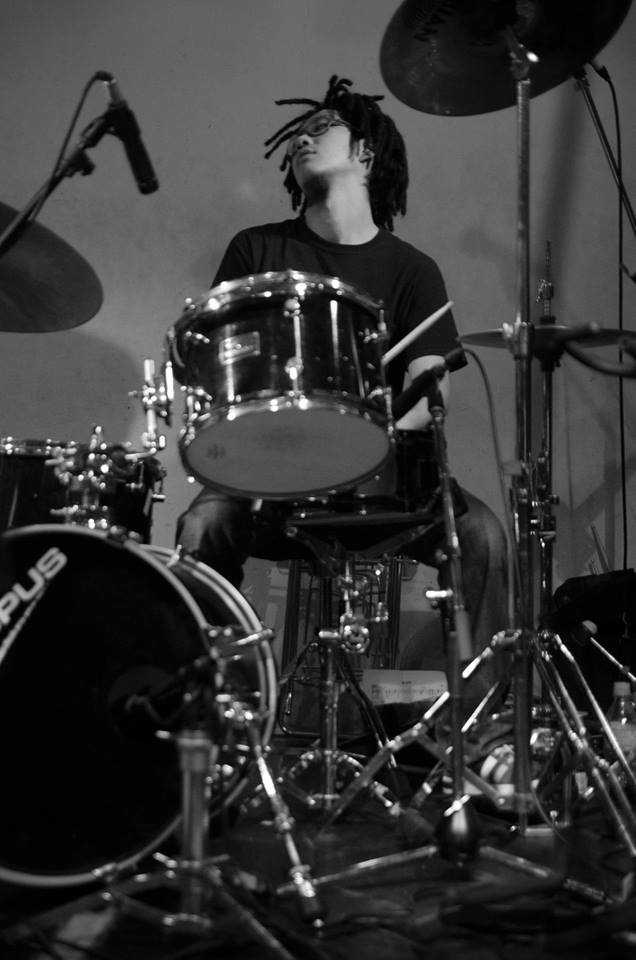
my son is
a drummer
he doesn’t yet
know the
blank spaces
of the world
are a gift
from that
grandfather
who was beaten for
a book
of
poems

Poetry with Music at Tokyo Woodstock

Poet YURI KAGEYAMA
reading “ode to the stoller” and “Little YELLOW Slut”
with the Yuricane
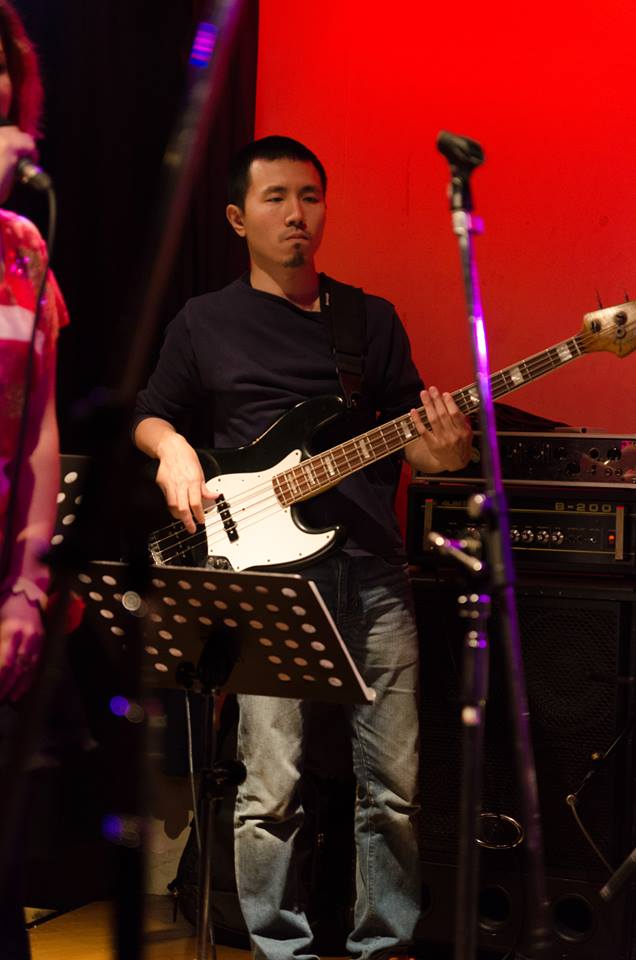
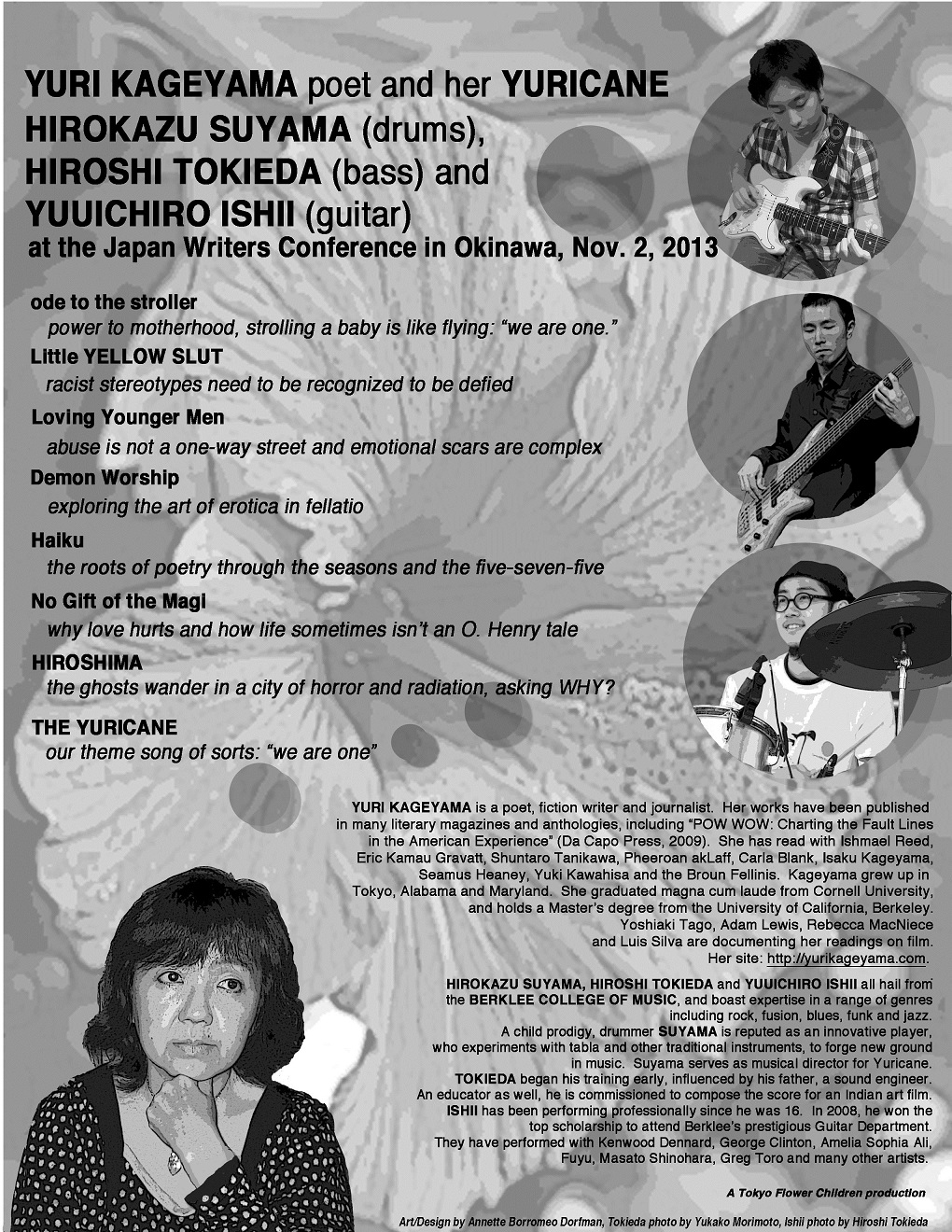
_ Hirokazu Suyama (drums), Hiroshi Tokieda (bass), Yuuichiro Ishii (guitar) and Winchester Nii Tete (kpanlogo drums)
at Tokyo Woodstock 2013 at What the Dickens,
Film by Luis Silva.
July 21, 2013.

ode to the stroller
a poem by Yuri Kageyama

we zip weightless like silent angels
up and down San Francisco hills
running on the mother of all energy
greener than solar
rolling rolling rolling
with laughter
cream acid rock ‘n’ rolling
lightning dazzling wheels
gara-gara-gara-gara
teethers jangling dangling dancing
going mad on strangle-free rubbery ribbons
up and down the Avenues
J-town, Clement Street
Golden Gate Park
Museum of Modern Art
we are singing:
“Ouma no oyako wa nakayoshi koyoshi
itsudemo issho ni pokkuri pokkuri aruku”
perfume wind in our hair
springing over potholes
not even stopping just for breast feeds
connected as one through this magical machine
me pushing
you riding
the Lamborghini of strollers
the Gundam of strollers
the little train that could of strollers
up up up into the joyous clouds
zooming wheeeeee
down slurping slopes
around swervacious curves
we are one
yes, we are one
tied in the past with our
umbilical cord
and
even in death
in our dreams

Little YELLOW Slut
a poem by Yuri Kageyama
first published in KONCH MAGAZINE, 2009.

You know her:
That Little YELLOW Slut, proudly gleefully
YELLOW-ly hanging on Big Master’s arm,
War bride, geisha,
GI’s home away from home,
Whore for last samurai,
Hula dancer with seaweed hair,
Yoko Ohno,
Akihabara cafe maid,
Hi-Hi Puffy Ami/Yumi,
Kawaiiii like keitai,
Back-up dancer for Gwen Stefani,
Your real-life Second Life avatar
Eager to deliver your freakiest fetish fantasies,
Disco queen, skirt up the crotch,
Fish-net stockings, bow-legged, anorexic, raisin nipples, tip-toeing Roppongi on
Stiletto heels.

Yessu, i spikku ingrishhu, i raikku gaijeeen, they kiss you,
hold your hand, open doors for me,
open legs for you, giggling pidgin, covering mouth,
so happy to be
Little YELLOW Slut.

Everybody’s seen her:
That Little YELLOW Slut, waiting at
Home, cooking rice, the Japanese
Condoleezza Rice,
Smelling of sushi,
Breath and vagina,
Fish and vinegar,
Fermented rice,
Honored to be
Cleaning lady,
Flight attendant for Singapore Airlines,
Charlie Chan’s Angel,
Nurse maid, gardener, Japan-expert’s wife,
Mochi manga face,
Yodeling minyo, growling enka,
Sex toy, slant-eyes closed, licking, tasting, swallowing STD semen,
Every drop.

Yessu, i wanna baby who looohkuh gaijeen, double-fold eye, translucent skin, international school PTA,
maybe grow up to be fashion model, even joshi-ana,
not-not-not happy to be
Little YELLOW Slut.

I recognize her:
That Little YELLOW Slut, rejecting
Japanese, rejected by Japanese,
Ashamed,
Empty inside,
They all look alike,
Faceless, hoping to forget, escape
To America,
Slant-eyed clitoris,
Adopted orphan,
Dream come true for pedophiles,
Serving sake, pouring tea, spilling honey,
Naturalized citizen,
Buying Gucci,
Docile doll,
Rag-doll, Miss Universe, manic harakiri depressive, rape victim, she is
You, she is me.

Hai, hai, eigo wakarimasen, worship Big Master for mind, matter, muscle, money, body size correlates to penis size,
waiting to be sexually harassed, so sorry, so many,
so sad to be
Little YELLOW Slut.
Japanophile _ Part 4 A Story by Yuri Kageyama

Japanophile _ Part 4
A story by Yuri Kageyama

They smiled sheepishly beneath long spiky brownish bangs _ their photos, lined up one by one in the doorway to the entrance.
“Do you have a preference?” the waiter asked.
I had to get the No. 1.
That was the only reason I was here.
I was prepared to pay a small fortune, maybe 100,000 yen for this service at a host bar in Tokyo’s Shinjuku.
But the anxiety must have been obvious as the waiter tells me there is a discount for first-time women customers, and the first drink is on the house.
The place is not as dark or as big as I expected.
It looks much like any bar with the overdone felt chairs, the giant glitzy chandelier hanging from the ceiling.
A mirror ball circles lazily over a tiny dance floor, just a corner where the tables have been nudged over.
The host wearing what looks like a cheap suit that is probably very expensive sits across from me.
“What are your hobbies? Tennis? Oh, I just love tennis.”
Finally the No. 1 finds time in between chatting with the bar women who frequent the host bars to come to my table.
This is what he says:

I saw him every day, always sitting with the homeless guys next to the theater in Kabukicho.
He was so tanned I could barely make out his looks, but I thought he could make a good host.
He was so pathetic. But he reeked this survival strength from his entire being that I liked.
He was learning how to help clean up the manga magazines the homeless guys had collected so they could sell it and get money.
I hear the homeless guys were giving him 1,000 yen here and there.
Otherwise, he would never have really survived, despite that strength I told you about that he was reeking.
One day, I told him to follow me, and I took him to the soba joint around the corner from the theater.
“Give him a bowl with everything on top, zenbunose,” I said.
He looked startled like he had never had noodles with everything on top.
It was just 1,280 yen. Nothing for me.
But maybe it was something he hadn’t had for a while.

I couldn’t believe what I was hearing.
Why had my son been there at a dingy theater district, of all places, so helpless he needed to count on the mercy of homeless people and a host?
At the same time, I was filled with gratitude toward what they had done for him.
And I hated myself for not having seen through what could have possibly sent him to this fate.

PREVIOUS INSTALLMENTS OF “JAPANOPHILE”

Shinimonogurui _ a Poem by Yuri Kageyama

Shinimonogurui _ a Poem by Yuri Kageyama

しにものぐるいにあいし
しにものぐるいにうんで
しにものぐるいにそだてて
またしにものぐるいにあいし
しにものぐるいに死ぬ

Japanophile _ Part 3 A Story by Yuri Kageyama

At first, I thought he was just out with his friends, cavorting with a woman. He could be in his car. In her apartment. In a manga cafe. Anywhere, really. He was already an adult, having turned 23 last month, at least, technically an adult.
For years, I had never stayed up awake at night, waiting to hear the click of the door when he returned after being out late.
I was a liberal mother, and I remembered all too well how I had stayed out all night and hadn’t come home until the wee hours of the morning.
When he was nowhere to be seen by 11 a.m., I assmed he had gone straight to his daytime activity.
But to make sure, I called on his cell phone, not expecting him to pick up, but leavine a message and then a text message: Are you OK?
He usually replied, quick enough to put my worries to rest, sometimes in single letters like “Y” for “yes.”
Then I knew I could stop worrying.
But this time, there was no reply.
When there was no sign of him by 5 p.m., I began to think about going to the police.
I had already called and sent email to several of his closest friends.
One said he had seen him yesterday at a soba joint in Roppongi, maybe about 4 p.m., but he had not said exactly where he was going, except that he was off to see “someone important for a possible future business.”
He appeared calm, his usual jovial self, the friend said.
Nothing extraordinary, he said.
Had he been caught up in an accident, or was he a victim of a crime?
I was really beginning to get worried, panicked.
The police officers showed up at my door in a pair, just like in the movies, the good cop and the bad cop.
One asked what was he wearing? What had he said were his plans?
The bad cop did not seem happy when I told him I had no clue what he was wearing, and I had not asked about his plans.
But when the bad cop began to turn to me, almost interrogatively, the good cop intervened and told me they would let me know if they heard anything, acting as though our little conversation at our doorstep was some missing-person report.
The more I realized how useless this procedure was, my fear grew, a hotness welling up and choking my throat, about what had possibly happened to my son, who had suddenly vanished.
He could be out there, somewhere, kidnapped by yakuza or fallen over a crevice in his car, alone, hungry, in pain and utter terror, waiting for me to come find him.

Previous installments of this story:

Part 1

and

Part 2.

ode to the stroller _ a poem by Yuri Kageyama

ode to the stroller
a poem by Yuri Kageyama

we zip weightless like silent angels
up and down San Francisco hills
running on the mother of all energy
greener than solar
rolling rolling rolling
with laughter
cream acid rock ‘n’ rolling
lightning dazzling wheels
gara-gara-gara-gara
teethers jangling dangling dancing
going mad on strangle-free rubbery ribbons
up and down the Avenues
J-town, Clement Street
Golden Gate Park
Museum of Modern Art
we are singing:
“Ouma no oyako wa nakayoshi koyoshi
itsudemo issho ni pokkuri pokkuri aruku”

perfume wind in our hair
springing over potholes
not even stopping just for breast feeds
connected as one through this magical machine
me pushing
you riding
the Lamborghini of strollers
the Gundam of strollers
the little train that could of strollers
up up up into the joyous clouds
zooming wheeeeee
down slurping slopes
around swervacious curves
we are one
yes, we are one
tied in the past with our
umbilical cord
and
even in death
in our dreams

A Reading of “ode to the stroller” by Yuri Kageyama at Jackson’s Garage in Tokyo 2013. With Yuuichiro Ishii (guitar), Hirokazu Jackson Suyama (drums), Hiroshi Tokieda (bass).

Photo by John Matthews.

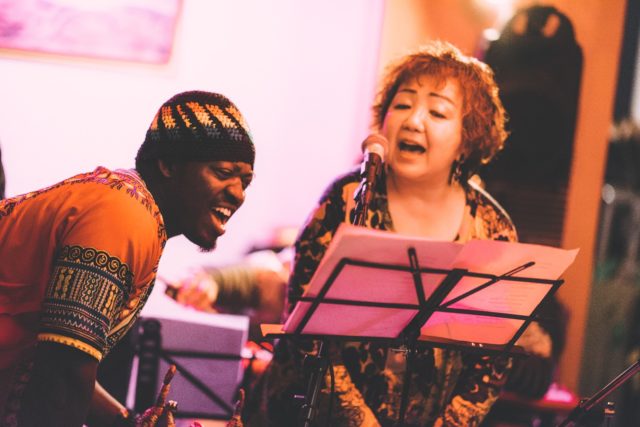
A Reading of “ode to the stroller” by Yuri Kageyama, also on percussion and random toys, with Kouzan Kikuchi (shakuhachi), Hirokazu Natsuaki (cello) and Winchester Nii Tete (percussion) January 2018, for a book party for Tokyo Poetry Journal, in which the poem was published.

TURNING JAPANESE poetry and reading by Yuri Kageyama

TURNING JAPANESE a poem by Yuri Kageyama
Film and Photos by Ian Thomas Ash
Reading by Yuri Kageyama
Wincester Nii Tete on percussion and Hiromichi Ugaya on bass at The Pink Cow in Tokyo for a “Looking At Fukushima” event May 7, 2013.

TURNING JAPANESE

a poem by Yuri Kageyama

Turning Japanese is not masturbation
Could even be for sale
So be proud

Take architecture:
We take space that’s smaller than a toilet
Create a garden to express the Universe
Todaiji Temple grandeur hierachy
It doesn’t even use any nails

Turning Japanese is not masturbation
Could even be for sale
So be proud

Take ikebana:
Flowers and herbs and blades of grass
Sculpture ecology Basho-esque balance
Homage to God’s perfection of design
It doesn’t even last a week

Turning Japanese is not masturbation
Could even be fore sale
So be proud

Take law and order:
Our trains are clean, run always on time
Apology on the PA if they’re two minutes late
The homeless politely take off their shoes
To get in their cardboard homes

Turning Japanese is not masturbation
Could even be for sale
So be proud

Take politics:
They tell us we have a democracy
Imported direct from the US of A
A new prime minister every year or so
What’s his name _ Koizumi, Abe, Fukuda, Aso, Hatoyama, Kan, Noda _ Abe again?
Please remember!

Turning Japanese is not masturbation
Could even be for sale
So be proud

Take women:
Excuse me, I mean, Take girls:
Uniform miniskirts, eyelash extensions
Never have jobs or grow older than 13
But grow Barbie’s breasts

Turning Japanese is not masturbation
Could even be for sale
So be proud

Technology:
Robots, Pokemon, gadgets galore
Attention to detail, precision with vengeance
We get everything right _ unless something goes wrong
Like a nuclear meltdown

Turning Japanese is not masturbation
Could even be for sale
So be proud

Celebration
Revolution
Masturbation
Nuclear nation
Hydrogen explosion
Can I have your attention
Masturbation
Radiation
Nuclear nation …..

Haiku Speak _ a poem by Yuri Kageyama

Haiku Speak
_ a poem by Yuri Kageyama

Waaaaaah! So much like Wow!
A Child. Fluttering Sakura.
Language. A Moment.

LOOKING AT FUKUSHIMA


The Asian American Journalists Association presents
“LOOKING AT FUKUSHIMA _ An Evening with Hiromichi Ugaya,”
a talk, photo slideshow and discussion session with a veteran journalist documenting a post-nuclear disaster landscape.

THE PINK COW
5-5-1 Roppongi Minatoku Tokyo Roi Building B1F
TUESDAY May 7, 2013 7 p.m. – 10 p.m.
2,500 yen for a Great Buffet is the only charge. Drinks pay as you go at the bar.
A public English-language event.
Come on time to catch a musical performance opening the event.
Musicians and poets welcome for Jam Open Mike to close the event.

Hiromichi “Hiro” UGAYA is a veteran journalist, photographer and educator, who has devoted his life recently to intensive coverage of the Fukushima nuclear catastrophe and the plight of the tens of thousands of people the accident has displaced. A former reporter at Asahi newspaper and writer for AERA magazine, he has authored more than half a dozen books on security issues, media criticism, Internet technology and Japanese pop culture. A graduate of Kyoto University, he holds a Master’s in International Security Affairs from Columbia University. His latest book “Fukushima’s Lost Seasons” is a poetic photo essay of the serene flowers and trees of the region that have been invisibly devastated by radiation. He is also a bassist and performs regularly at Tokyo clubs.