Amanojaku concert at Sogetsu Hall in Tokyo Dec. 8, 2009.
“Kaiun” by Yoichi Watanabe, performed by (from left to right) Daisuke Watanabe, Isaku Kageyama, Yoichi Watanabe and Hiromi Ogawa.
Amanojaku at Sogetsu Hall
The Autobiography of Yoichi Watanabe 2

Isao Tokuhashi and I are working together in compiling an oral history of Yoichi Watanabe, the leader and founder of Tokyo taiko group Amanojaku.
Link to an earlier excerpt, and below another excerpt from the work-in-progress, “The Autobiography of Yoichi Watanabe _ as told to Isao Tokuhashi and Yuri Kageyama”:
Most teachers set a two hour or three hour lesson and charge for those hours.
I don’t do that. When I teach a group, I teach from morning until night. That’s because we are going toward the same dream.
Maybe this makes me unprofessional. But I want to be moved. If the people I am involved with are passionate about the music, and they are moved, then I am moved. If I am dishonest to what I believe, I think people will see that.
And so I don’t think about the hours. It’s impossible to teach or create what I want in two or three hours.
The people who perform with me often break into tears. That’s when a teacher can feel truly fulfilled. That’s what I live for.
It’s the same if I go abroad. It gets very busy when I go to Brazil. There is no rest. We are going to lessons from morning until night. But some of the kids are waiting at the hotel for us to get back because they so much want to learn.
I believe that being a taiko drummer was the best job for me. But I also believe that it was a mission given to me by the heavens.
I needed to write a page in taiko history. I wanted to pave the way for those who come after me.
I needed to be able to teach with confidence or else my students won’t be able to play with confidence.
A professional performance is not a recital for friends.
A professional must be spiritually strong like an Olympic athlete undergoing Spartan training.
But without a relationship of trust, a teacher cannot make a student go through that kind of training. If you have not endured this kind of training, and become truly professional, you will be ignored in the professional world.
It all depends on the person. Some need to be scolded. Some need to be praised. Some pick it up without your having said a word, while others never get it even if you tell them many times.
I created the original music that is Amanojaku.
I never wavered. I was always going straight after that goal.
If the roots of a tree are rotten, then it will never flower. But if the roots are solid, the stem will grow strong.
While others paint in colorful oils, I am taking a sumi brush and painting to find my own way. Once I decided that, the rest was easy
Drumming in 2010


A HAPPY UPBEAT NEW YEAR with taiko drumming by Isaku Kageyama with Seijuro Sawada on shamisen _ all to House DJ-ing _ at the Mandarin Oriental in Tokyo during the countdown celebrations Dec. 31, 2009 and Jan. 1, 2010. Dancing, champagne, music and plenty of multicultural spirit to guide us through 2010.
Another video at this link.
Countdown Party

Seijuro Sawada, shamisen prodigy, will be collaborating with taiko drummer Isaku Kageyama in a multicultural Countdown Celebration at the Mandarin Oriental in Tokyo,
The Sanctuary 3F.
2-1-1 Nihonbashi Muromachi, Chuo-ku, Tokyo
Nearest Station: Mitsukoshimae.
Welcome in 2010 with taiko and shamisen performed by masters to DJ House and start the Year of the Tiger right.
Contact Isaku for reservations and discount admissions.
AMANOJAKU Taiko at Sogetsu Hall in Tokyo
THE BEAT OF LEGACY – Dentou no Hibiki
AMANOJAKU Taiko Concert in Tokyo
TUE Dec. 8, 2009
Sogestsu Hall
7 p.m. (doors open 6:30 p.m.)
For tickets, please email: isaku.kageyama@amanojaku.info
Featuring composer, Amanojaku leader and founder YOICHI WATANABE
with HIROMI OGAWA, ISAKU KAGEYAMA, DAISUKE WATANABE, CHRIS HOLLAND and HIROMI SEKINE; guest on fue KYOSUKE SUZUKI.
The Autobiography of Yoichi Watanabe
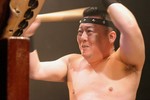
Yoichi Watanabe, (photo by Naokazu Oinuma) leader of Tokyo taiko group Amanojaku, is relating his life history and his thoughts on taiko to Isao Tokuhashi and me.
It is a project that has just begun. And a lot of work still awaits.
But it fascinates me for what it promises to deliver in understanding of a great artist, an important era of post-war Japanese creativity and the conceptual and spiritual backbone of modern music called taiko.
Yoichi Watanabe founded Amanojaku in 1987.
But his story _ one man’s journey in taiko _ began in the late 1960s, when he was about 10 years old.
He lived through the pioneering years of Tokyo-style taiko, playing with Sukeroku Daiko, founded in 1959 as this city’s first professional kumi-daiko troupe.
An excerpt from “The Autobiography of Yoichi Watanabe _ as told to Isao Tokuhashi and Yuri Kageyama”:
To be honest, I am not sure anyone would want to read a book about my life.
Besides, 10 years from now, my thoughts are bound to have changed, and I would need to write another book.
But I’ve always wanted to write down a certain philosophy on life that I have arrived at over the years in my own small way.
There is such a thing in life as the correct path _ a “seido.”
I am no different in having pursued what I thought was this correct path for me.
I have been doing it all my life.
I was in fourth grade when I decided I wanted to be a taiko drummer.
And I have never swerved from that path.
And it was just one path.
It was not an easy path, one filled with thorny bushes along the way.
But I have developed a way of looking at life through taiko.
And so this book is not a manual about how to play taiko.
Please look at a DVD or a read a manual textbook for that.
Everyone starts out with a dream, and then many people arrive at another way of life to make a living.
You may want to be a doctor or a pilot. But if you can’t realize that dream, you may have to settle on a more realistic job.
We are supposedly in the worst crisis in a century.
People are all working hard.
Perhaps they would be encouraged to find I have never gone far astray from my path over all these years.
I don’t have anything all that special to say.
It’s very ordinary. It’s no different from everyone else’s dreams.
If you keep yourself open, then you will realize your goal in all its depth and breadth.
That kind of spirit has been lost, this spirit I have strived to pursue all my life.
It’s human to seek the easy way, but I have stuck to the way even if it meant hardships.
If people tell me to go one way, then sometimes I question that and go counter-clockwise.
I have always been a rebel, an Amanojaku.
Isaku takes a stand
It is so important for a person to take a stand for the music, or whatever else, he or she stands for.
And Isaku really took a stand _ literally on his cajon _ with Winchester Nii Tete and Cari at “The Beat Ahead” at Harajuku Crocodile in Tokyo.
Isaku Kageyama has been playing professionally for years in Amanojaku, the taiko troupe led by his master teacher Yoichi Watanabe, as well as other contexts.
Those situations often required the player to carry out the vision of the leader or pull the whole group together.
A lot of musical technique, hard work and dedication is involved in carrying that out.
But something different happened that night.
Isaku told his own story, holding his own with full accountability for what he stands for _ his own colors, his own music, his own view of the world.
It was a cathartic moment for my son _ and for me.
All the technique in the world doesn’t make sense or take meaning without this sense of purpose.
And that’s what makes it all _ the pursuit of technique, the years of hard work, the struggles of everyday life _ worth it: That real purpose.
It was stunning to see the transformation before me, although I knew all along someday it would happen.
I forgot to take photos.
more on YouTube
“The Beat Ahead” opened with a rock group led by Isaku’s new collaborator Yuu Ishizuka, who hails from Oedo Sukeroku Taiko.
The closing segment was all taiko with Isaku and Yuu collaborating.
It was great to see drummers from different backgrounds share ideas and create new sounds _ something that surprisingly happens rarely in the world of taiko.
There is so much more to be explored.
Interviews with Isaku Kageyama on taiko

Isaku Kageyama, taiko drummer with Amanojaku, has an interview in the latest Metropolis, Tokyo’s entertainment magazine.
He is interviewed in Japanese in Moonlix magazine, which has also interviewed Ryuichi Sakamoto and Yoko Ohno _ pretty good company.
Isaku is putting on a rare kind of show _ a collaboration of taiko drummers from two different schools _ with Yuu Ishizuka at the Crocodile near Harajuku, Tokyo, Thursday Oct. 22, 2009.
Also appearing that evening will be Winchester Nii Tete from Ghana, Chris Holland from Denver and others.
THE BEAT AHEAD
THU OCT. 22, 2009.
from 7:30 p.m.; doors open at 6 p.m.
Harajuku Crocodile
TEL: 03-3499-5205
ADDRESS: 6-18-8-B1 Jingu-mae Shibuya-ku Tokyo 150-0001.
3,000 yen for advance tickets, 3,500 yen at door.
OTHER EVENTS:
Isaku performs with Winchester at the MOON STOMP in Koenji tomorrow night, SUN Oct. 11.
Starts 8 p.m., doors open 7 p.m.
A good deal at just 1,000 yen door charge.
The following day, MON Oct. 12, a national holiday in Japan, Isaku plays minyo (Japanese traditional folk music) at TAKANOYA in Shinjuku, Tokyo, with singing, shamisen and shakuhachi.
Starts 7 p.m., doors open 6:30 p.m.
Advance tickets 2,000 yen plus one drink at 600 yen.
At door 2,500 yen plus one drink at 600 yen.
"My Eyes Tokyo" interviews Isaku Kageyama

Photo by Naokazu Oinuma.
A podcast interview with Isaku Kageyama and his music by “My Eyes Tokyo,” from Isao Tokuhashi.
“If I didn’t play taiko, I don’t know where I would be. I don’t know what I would be doing right now. I might not be alive. I might be in jail.”
Taiko gigs
Photo by Ryan Bruss.
OCT. 4, 2009
AMANOJAKU concert at Kuroiso Bunka Kaikan,
490 Kami Atsu-zaki Nasu Shiobara-shi Tochigi 325-0026.
For tickets, please call 0287-63-3219.
Doors open 1 p.m. Music starts 2 p.m.
2,000 yen (1,000 yen for students).
OCT. 12, 2009
MINYO “LIVE” at Shinjuku Takanoya. 03-5919-0228.
Isaku Kageyama (taiko) with Rie Sakamoto (song), Seiemon Sawada (shamisen), Yoshinori Kikuchi (shakuhachi).
5-2-3-B1 Shinjuku Shinjuku-ku Tokyo 160-0022.
Doors open 6:30 p.m. Music starts 7 p.m.
Advance tickets 2,000 yen; at the door 2,500 yen.
For reservations, email: isaku.kageyama@amanojaku.info
OCT. 17, 2009
AMANOJAKU at DECHIKONKA, annual festival in Ehime Prefecture.
Call Kihoku city hall at 0895-45-1111.
Starts 6 p.m.
OCT. 22, 2009
THE BEAT AHEAD _ Wadaiko “live” at Harajuku Crocodile.
Featuring Isaku Kageyama and Yuu Ishizuka on taikos with Winchester Nii Tete, Chris Holland and other guests.
Call The Crocodile at 03-3499-5205.
6-18-8-B1 Jingumae Shibuya-ku Tokyo 150-0001.
Doors open 6 p.m. Music starts 7:30 p.m.
Advance tickets 3,000 yen. At door 3,500 yen.
For reservations, email: isaku.kageyama@amanojaku.info
DEC. 8, 2009
AMANOJAKU at SOGETSU HALL.
Call Sogetsu Hall at 03-3408-1154.
7-2-21 Akasaka Minato-ku Tokyo 107-8505.
Doors open 6.30 p.m. Music starts 7 p.m.
For reservations, email: isaku.kageyama@amanojaku.info
JAN 10, 2010.
AMANOJAKU Student recital TENSHONOKAI.
Kameari Lirio Hall 03-5680-2222.
Doors open 2 p.m. Music starts 2:30 p.m.
1,000 yen donation.
JAN. 15-FEB. 8
AMANOJAKU workshops in Brazil.
APRIL 18, 2010.
AMANOJAKU concert at TOKYO FM Hall.
Doors open 5:30 p.m. Music starts 6 p.m.
Tokyo FM Hall 03-3221-0080.
1-7 Kojimachi Chiyoda-ku Tokyo 102-0080.
For reservations, email: isaku.kageyama@amanojaku.info