This haiku is about that everyday moment when you are waiting to cross a busy street, and you see a very old couple standing in front of you, and you happen to notice they are holding hands, clasping each other’s fingers, like they are holding on for life, or for eternal love. Like they’re on their first date, although they are old _ white hair, frail, pale skin, barely standing, leaning against each other. All you can feel is sheer envy: That they have whatever it is that they have, all the years together, and, most of all, they have each other.
Swimming or flying
Mourning alone will end soon
Love birds mate for life
If you are a bird watcher, even a casual amateurish one like me, you know many of them not only migrate in flocks, like a flight version of human society, but they are also almost always couples. If you ever see a bird alone, look around and find his/her partner nearby. I enjoy doing this. I find it consoling each time.
at Senshin Obon in LA this year a very special lantern
IT IS OK a poem by Yuri Kageyama
it is OK
to idealize
he is now
an angel
or
at least that’s
what they say
he never laid eyes on another
he always brought home the pay check
he never broke anything
and he never snored
it is OK to believe
all those things
and think he was, will be
perfect
This piece came about as part of the Poetry Challenge, a group in Tokyo that shares work on a given theme. The theme was “Dreamtime.” I’m sharing it here because it turned out nicely, if I may say so, with the title “It Is OK.” Below is what our son Isaku did with the poem, using AI to make it into a song:
A song about love with Words written by Yuri Kageyama and Music and song by Ryu Miho
what do you think?
it’s a trick question
what do you think?
with a right answer
what do you think?
not at all open-ended
what do you think?
as it might seem
what do you think?
it’s asking do you really love me?
do you truly understand?
what do you think?
the answer isn’t fixed
just a right answer, and a wrong
what do you think?
i love you so much
what do you think?
and long after we’re all gone
what do you think?
that big question is still there
what do you think?
what do you think?
Lovers are always asking each other: “What do you think?” and getting upset if their lover doesn’t quite get it, or answers he or she felt something about an artwork or a film they just saw together in a different way from what you’re feeling, or thought the feeling should be, or whatever. It’s really a fruitless game, but it’s one all lovers play, all the time, throughout history, wherever they are, any nation, any culture. Because ultimately you’re just asking: Do you love me? And there is no right answer or a wrong one. Just that moment you share, you are both here, alive but together on this little beautiful planet, lost in the cosmos, and we never know what to think anyway.
And this version as arranged and performed by Toshiyuki Turner Tanahashi.
We presented “What Do You Think” at a Tokyo bar together May 3, 2026. A man came up and told us his wife always asks him that, too, and he never has the right answer so he’s given up. And so: What do you think?
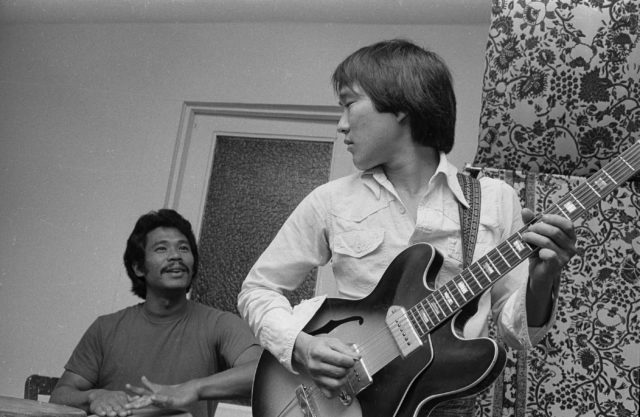
Gordy with Duke in San Francisco 1979. Photo by Bob Hsiang.
I now know it’s all the same thing, love and music. Or the poem, flower arrangement or any other pursuit. It’s about connecting with all that went before you, in all their trials and tribulations, everything. And love is a part of that, your connecting with that person you love. Maybe your friend, your mother, your partner for life. It might get complicated if you are trying to connect with the past, while at the same time trying to connect with that individual, who in turn may also be connecting with the musical or theatrical greats who went before him or her. But, hey, it’s all the same thing. It is how you live and how you choose to connect. And it is definitely a lifelong effort. Worth every second. Filling you with joy and meaning about having known those special connections, and that special person. So do not mourn. Just rejoice. Keep playing, writing, creating and loving.
The poem as sung by Miho Ryu with music arranged and performed by Toshiyuki Turner Tanahashi.
Love Simply
To be near hurts
To be far hurts, too
Love simply hurts
To live hurts
To die hurts
Love simply hurts
Watching you die
Hurts even more
Love simply hurts
To know you hurts
To have known you hurts
Love simply hurts
But to not know you,
Not hurt for you
Is simply not a choice
Love simply hurts
Love simply hurts
Love simply hurts
「愛はただ痛い」
a poem by Yuri Kageyama translated into Japanese by Ryu Miho
近くにいるのもまた辛い
遠くにいるのもまた辛い
愛はただ痛い
生きるのもまた辛い
死ぬのもまた辛い
愛はただ痛い
あなたが死ぬのを見るのは
もっと辛い
愛はただ痛い
あなたを知るのもまた辛い
あなたを知っていたのもまた辛い
愛はただ痛い
でも、あなたを知らないのは
あなたのために傷つかないのは
ただ選択できない
愛はただ痛い
愛はただ痛い
愛はただ痛い
A rendition by Teru Kawabata with his singing and guitar. August 2025.
This poem, now lyrics to a song, was written in 2023. It is still developing, but I feel it has come full circle. It still makes me cry. My love is still so very real and, I know, eternal, which means the pain will never go away. It is overwhelming and frightening. But I now know many people feel this way. It is a feeling that comes only with someone you truly love. The wonderful thing is that I was able to show him my poem. He just said, “I feel loved.” The look he had on his face was like a child, totally fulfilled and happy. And what else is a poem meant to do?
I read “Love Simply” with music by Jackson on drums and Teru singing and playing guitar of the music he wrote at an open-mic in Tokyo Oct. 5, 2025. Thanks for having us and being such a fun crowd.
I read my poem “Love Simply” with Teruyuki Kawabata on guitar and Osaki Haniya, fellow poet and co-writer of “Continuously Poetry,” at Bar Gari Gari in Ikenoue, Tokyo, Sept. 19, 2025. Thanks to the Drunk Poets for having us.
Besides the Book Party, I also earlier read “Love Simply” with Teru at Infinity Books, on Oct. 11, 2025. Before I read, I told the people at the jam session that the poem was about my partner of more than 40 years, who died in April. I don’t think I ever said that in public about my poem. I also told them that I showed him the poem before he died, and he told me he felt loved. You know how you feel a bit drained, depressed even, after reading your work. But one young man who was there to jam told me he liked my poem, then said: “Your husband is one helluva lucky man.” That made it all worth it. And I thanked him.
People say things have little meaning, and it’s just the person or the emotions that the thing reminds you of that have meaning. Sometimes they are one and the same thing because if you have something for more than 40 years, that certainly means something, and that thing has a meaning of its own. People leave, taking off from this world and going somewhere very far. But the thing stays. And it continues to tell us what that person means. Because that person never really leaves. He is always here, just like, or even more than, that thing. This is the fourth in a series that follows this third piece, which has a link that connects to the previous pieces. After this are three more: “Love Simply” and “What Do You Think?” as well as “Your Music.” And I get the feeling there will be more because that feeling never dies.