My Ikenobo Ikebana


My previous ikebana with a link to more.


My Ikenobo Ikebana
My previous ikebana with a link to more.
My AP Stories for 2025

My AP Story Nov. 21, 2025, a co-byline with my colleague Terry, about the “rental family” business in Japan and the Hollywood film starring Brendan Fraser it inspired. Click on the link below to see the Video for the Story:


My AP Story Nov. 12, 2025 on “Last Samurai Standing,” for which I interview Junichi Okada, as in the video below:

My AP Story Dec. 8, 2025 on Japan’s revised GDP data.

My AP Story Nov. 11, 2025 on SoftBank saying it’s sold all its stock in Nvidia.

My AP Story Nov. 11, 2025 on Sony’s profits soaring because of blockbuster “Demon Slayer.”

My AP Story Nov. 7, 2025 on Honda’s profits slipping because of Trump’s tariffs.

My AP Story Nov. 6, 2025 about Nissan’s selling its Yokohama headquarters building as it reports losses.

My AP Story Nov. 5, 2025 about Toyota reporting lower profits as a result of tariffs.

My AP Story Nov. 2, 2025 about Japan celebrating the Dodgers becoming the 2025 World Series champions.

My AP Story and My AP Photo Oct. 30, 2025 on how fans are rooting for Shohei Ohtani.


My AP Story Oct. 30, 2025 and My AP Photo on the Tokyo auto show.


My AP Story Oct. 21, 2025 about the newly elected Prime Minister Sanae Takaichi’s economic policies.

My AP Story Oct. 22, 2025 on Japan’s trade data for September.

My AP Story Oct. 3, 2025 on the AI collaboration between Nvidia and Fujitsu.

My AP Story Oct. 3, 2025 about the cyberattack on Asahi.

My AP Story and My AP Photo Oct. 1, 2025 on Japan’s minister negotiating on Trump’s tariffs.

My AP Story and My AP Photos Sept. 22, 2025 about Nissan’s self-driving technology.

My AP Story Sept. 3, 2025 about a film about the Kabuki theater becoming a big hit.

My AP Story Sept. 3, 2025 when that former executive asserts his innocence.
My AP Story Sept. 2, 2025 on an executive’s resignation at Suntory over drug allegations.

My AP Story and AP Photos Aug. 22, 2025 on the popularity of matcha outside the tea ceremony.

My AP Story and My AP Photos Aug. 8, 2025 about bugs being pets in Japan.


My AP Story July 26, 2025, in which I interview the great Japanese director Kiyoshi Kurosawa.

My AP Story and My AP Photos July 25, 2025 on how AI is being used in traditional weaving. I also did AP Video.


My AP Story July 22, 2025, a book review.

My AP Story July 8, 2025 on Japanese boxing star Junto Nakatani, a story relayed to the world as a Top Story for The Associated Press.


As a reporter, I am privileged to meet some of the best people in the world, like this champion, Junto Nakatani. When I asked him about how he is always smiling, even in the ring, he told me matter-of-factly that it is a disadvantage to get angry because “you lose control.” Obviously, boxing is all about winning. He also said he believes winning by knockout is what is “expected” of him. And I felt like a mom, as I often do at interviews, and in life, because I am one, and couldn’t help but respond with an empathetic: “Hey, it’s OK to just win.” Which goes to say that Nakatani is a very special person _ to bring that out in you.


My AP Story and My AP Photos July 9, 2025 on Tsukudani, a traditional dish made in Tsukuda, Japan.


My AP Story and My AP Photos July 9, 2025, a recipe for Tsukudani.


My AP Story July 17, 2025 on Canada’s Couche-Tard dropping its attempt to acquire 7-Eleven.

My AP Story July 15, 2025 on Nissan ending vehicle production at its flagship Oppama plant.

I’m a Contributor to this AP Story June 24, 2025 about travel disruptions because of Middle East tensions.
My AP Story June 10, 2025 on the merger of the truck units of Toyota and Daimler.

My AP Story June 9, 2025 on a sumo wrestler’s retirement.

My AP Story May 27, 2025 and My AP Photo on the new CEO approved by shareholders at 7-Eleven.

My AP Story May 26, 2025 and My AP Photos on Nissan’s e-Power technology.


My AP Story May 20, 2025 on Honda delaying its electrification strategy to focus more on hybrids.

My AP Story May 21, 2025 on Japan’s trade data that show exports falling.

My AP Video Story May 13, 2025 on collectors’ cards being authenticated and evaluated in Japan.

My AP Story May 16, 2025 on Japan’s economy contracting.

My AP Story May 13, 2025 on job cuts at Nissan.

My AP Story May 14, 2025 on record profits at Sony.

My AP Story May 13, 2025 on profits falling at Honda.

My AP Story May 13, 2025 on SoftBank reporting a profit for the first time in four years.

My AP Book Review May 6, 2025.

My AP Story, My AP Photo and My AP Video April 23, 2025 on “Bullet Train Explosion.”


My AP Story May 9, 2025 on job cuts at Panasonic.

My AP Story May 8, 2025 on Toyota’s financial results.

My AP Story and My AP Photos May 1, 2025 on May Day around the world.

My AP Photos are part of this Gallery on May Day.

My AP Story April 22, 2025, a book review on a memoir.

My AP Story April 18, 2025 on a Star Wars event in Japan.


My Co-Byline AP Story May 5, 2025 about Trump’s trade demands.

My AP Story April 30, 2025 on the collaboration between Toyota and Waymo.

My AP Story and My AP Photos April 25, 2025 on the CEO-to-be of the 7-Eleven chain.
My AP Story April 24, 2025 about Nissan’s earnings forecast.

My AP Story May 2, 2025 about a minister’s comment on Japan’s U.S. Treasury holdings.

My AP Story April 17, 2025 on Japan’s trade data.

My AP Story April 15, 2025 about Japanese regulators accusing Google of monopolistic behavior.

My AP Story and My AP Photos April 10, 2025 on a machine that measures the fattiness of tuna.

My AP Story April 6, 2025 on a helicopter crash.

My AP Story April 1, 2025 on a major survey about sentiments on the economy.

My AP Story and My AP Photos March 26, 2025 on Nissan’s soon-to-be CEO.

My AP Story March 18, 2025, a book review.

My AP Story March 13, 2025 on 7-Eleven.

My AP Story March 11, 2025 on Nissan replacing its chief executive.

My AP Story and My AP Photos March 10, 2025 on Nissan’s driverless vehicles.


My AP Story and My AP Photos Feb. 22, 2025 on a city Toyota is building near Mount Fuji.


My AP Story Feb. 25, 2025 on Toyota trying to add diverse views to its board.

My AP Story and My AP Photos Feb. 19, 2025 on marketing Japan’s elderly.


My AP Story Feb. 17, 2025 on Japan’s economy.

My AP Story Feb. 13, 2025 on Nissan and Honda dropping their talks for a business integration.

My AP Story Feb. 5, 2025 on Toyota’s EV initiatives in China and the U.S.

My AP Story Feb. 4, 2025 on the appeals court ruling on the case of Nissan’s former executive Greg Kelly.

My AP Story Jan. 16, 2025 on a YouTube star with eyes now on a global audience.

My AP Story Feb. 3, 2025 on the partnership between SoftBank and OpenAI for smarter artificial intelligence.

My AP Story Jan. 30, 2025 on Nissan’s job and production cuts in the U.S.

My AP Story Jan. 24, 2025 on the Bank of Japan raising interest rates.

My AP Story Jan. 23, 2025 on Japan’s trade data.

My AP Story Jan. 16, 2025 on bank executives taking pay cuts after acknowledging an employee stole from customers’ safe deposit boxes.

My AP Story Jan. 13, 2025 on the quake that hit southwestern Japan.

My AP Story Jan. 7, 2025 on Nippon Steel determined to push its US Steel takeover.


My AP Story Jan. 5, 2025 about a Nagasaki bombing survivor, who has died.

My AP Story Jan. 4, 2025 on the death of the world’s oldest person.

My AP Story Jan. 2, 2025 on the well-wishers at the Imperial Palace.

I’m a Contributor to this AP Story Jan. 1, 2025, which started out as My last AP Story for last year.

My Shoka Ikebana Nov. 5, 2025. My previous ikebana pieces here with links to even more previous ikebana.

This arrangement has the feel of autumn. The yellow chrysanthemums are the main objects. But the susuki grass blades add dynamism to the composition, while the brown-tinged leaves to the side have their own distinct personality.
My teacher said it was interesting I kept the blades long, and very much like me, which I think he meant in a positive way, as in a free spirit.
More of my ikebana at these links: No. 5 No. 4 No. 3 No. 2 and My No. 1 Ikenobo Ikebana.

I was allowed to choose my vase and so it’s a rather unusual shape this time that really stimulates your imagination as to where the leaves and flowers should be, can be, wants to be, or are speaking to your soul to be. The beauty of Ikebana is that it is a conversation, silent but certain, not only with the elements of Nature but also with things like a vase, specially made by an artist for Ikenobo Ikebana, an individual. You are also relating to many other people, your ikebana teacher, of course, and your inner self, but, more significantly, memories of people, like your mother, who taught you your first lessons in ikebana, pride and joy in your Japanese heritage, and recognizing beauty and the message of impermanence in Life.
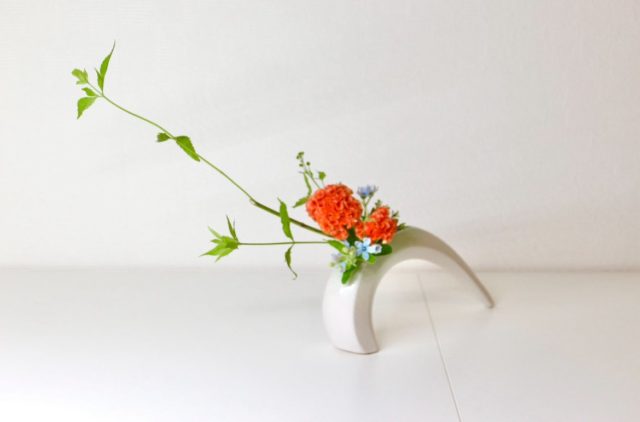

My Ikenobo Ikebana No. 4 is here with links to the previous works.

The star of today’s ikebana are roses from Kenya called Game Changers, arranged in a wine glass partly filled with plastic crystals. My earlier Ikebana: My first ever Ikenobo Ikebana. Part Two or my Second Attempt. And Part Three.

Two and a half weeks later, the flowers have gone dry but are still vibrant with color. My teacher told me to watch for the flowers as they go dry, and, although I found just three pieces this time, they look grand and happy in the Hagiyaki plate. My parents lived in Yamaguchi Prefecture, where Hagi is located, and my father was a professor after retiring from an engineering company. They became friends with a lot of Hagiyaki artists and got their works at bargain prices. I treasures all their Hagiyaki pieces. There is a whole universe in this arrangement. And the messages that beauty _ and life _ do not end with death.
Hiroshima On Our Minds. Prime Minister Shigeru Ishiba read a tanka poem by Shinoe Shoda at the end of his speech this year. He read it twice, which was not initially planned, saying: “With a flood of emotions as I reflect deeply on those words, I hereby conclude my address.”
The official translation:
The heavy bone must be a teacher’s. The small skulls beside it must be students gathered around.
The big bone a teacher
Nearby tiny skulls
Huddle close
The original Japanese:
太き骨は先生ならむ
そのそばに小さきあたまの骨
あつまれり
The words of the Hiroshima poet, who wrote extensively about the horrors of war, are engraved in a memorial in that city. She died in 1965.

Today’s Ikenobo Ikebana used a sponge called “oasis,” because it’s apparently made by a company called Oasis, to arrange the flowers in a way that was quite three-dimensional but required the placement of the leaves at the bottom to “hide” the sponge. The teacher said to start with the main elements, the sunflowers. You place one sunflower, then the other sunflower, always lower than the first. The other elements are basically fillers for the empty spaces, but you have to think where those spots are and balance them. You can play around with the long leaves, even bending them with your fingers. But always remember the tips must look up, never droop. Adding the water comes last. The speckles of glitter reflecting in the vase are gorgeous and an understatement at once.

My Second Ikenobo Ikebana

Actually my teacher told me it’s against the rules to let a flower that broke off float in the water, when I did it. But when he took the photos at the end of the class with all the lighting set up, or actually another student and me holding them up, he took the flower, dropped it in the water and took this photo. He is a nice teacher. Although allowed in other styles of Ikebana, Ikenobo did not, seeing fallen flowers as death, and his works are about life, purity and our eternal connection to the spiritual. It made me sad that death is so beautiful. And I like this photo.

My First Ikenobo Ikebana

My first ever attempt at Ikenobo style Ikebana. May 21, 2025.