Old Wounds _ a poem by Yuri Kageyama

OLD WOUNDS
_ a poem by Yuri Kageyama

the pain throbs
gnarled stuck intestines
wobbly knobs of scars inside
tracing where the knife slashed
to deliver your son
so many years ago
the bleeding has healed

betrayal, forgiven but not forgotten,
sealed lips of hushed kisses,
the chasm of hurt
tugging, tearing at your chest,
has turned into heartbeats
fading with age
just going

da-thump da-thump da-thump
barely murmurs
whispers of skin
you were young then
and had dreams,
not knowing other things,
unlike honor,

can elude,
again, and again,
for skin color, sex, age,
growing used to anonymity
outgrowing disappointment
but old wounds
they hurt like new wounds

DECONTAMINATION GHOSTS _ a performance poem by Yuri Kageyama (excerpt from “NEWS FROM FUKUSHIMA: Meditation on an Under-Reported Catastrophe by a Poet”

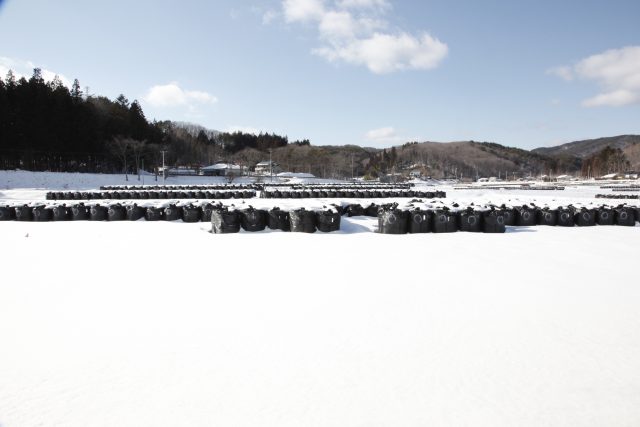
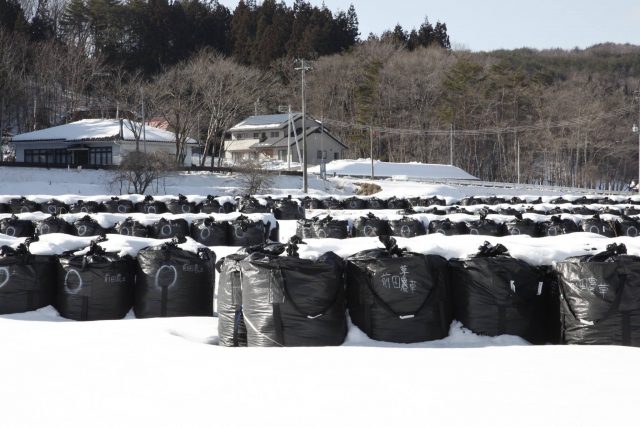
Mounds of bags in Fukushima
Mounds of bags called “flexible containers,” or “fle-con,” in Fukushima. Photo by Yuri Kageyama.

DECONTAMINATION GHOSTS a performance poem by Yuri Kageyama an excerpt from “NEWS FROM FUKUSHIMA: Meditation on an Under-Reported Catastrophe by a Poet” being performed at Z Space in San Francisco July 8-9, 2017. Written by Yuri Kageyama. Directed by Carla Blank. Performed by Takemi Kitamura, Monisha Shiva and Shigeko Sara Suga with Music by Melvin Gibbs, Isaku Kageyama and Kouzan Kikuchi. Lighting by Blu. Film by Yoshiaki Tago.

(with video and Drum and Fue, as in Kabuki Ghost scenes)

(In English speak normally, quickly)
Flexible Container
(Chant very slowly in Japanese, both voices together)
Fooh reh kooh she boo rew
Kon tay nah
Fooh reh kooh she boo rew
Kon tay nah
Fooh reh kooh she boo rew
Kon tay nah

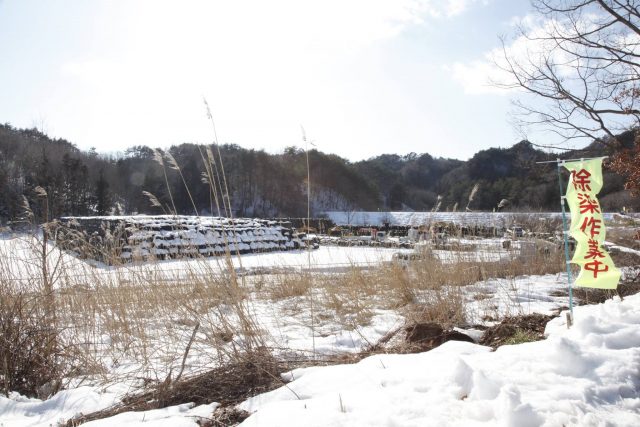
Decontamination Efforts in Fukushima. Photo by Yuri Kageyama.

Flexible Container
Foo reh kon
Foo reh kon
Foo reh kon
(One voice starts counting slowly and keeps counting slowly in Japanese. Overlay as the other voice starts, with the slow mechanical Japanese chant)
Hitotsu Futatsu Mittsu Yottsu Itsutsu Muttsu Nanatsu ….
Foo reh kon
Foo reh kon
Foo reh kon
Fooh reh kooh she boo rew
Kon tay nah
Kon tay nah
Kon tay nah
(fade out)

Note to readers: The Japanese government is backing expensive projects for giant shovels to scrape off topsoil in a stretch of land as big as the state of Massachusetts, and storing them in plastic bags, mounds and mounds of them _ 13 million flexible containers by the official count _ so areas in Fukushima can be declared safe enough for people to come back and live. This wasn’t attempted in Chernobyl, or any place in the world. The government is ending aid in March for those who evacuated from the areas being declared safe after decontamination. Before the 2011 nuclear accident, the government used to set the safe limit for radiation exposure at about 1 millisievert a year. But these days health experts are saying the definitive link with cancer is detected scientifically at 100 millisieverts a year or higher, and so Fukushima people at most will be exposed to far less at under 20 millisieverts, which, they say, would be safe.

Decontamination efforts in Fukushima
Decontamination efforts in Fukushima. Photo by Yuri Kageyama.

HAIKU FOR SAGIMUSUME _ a poem by Yuri Kageyama

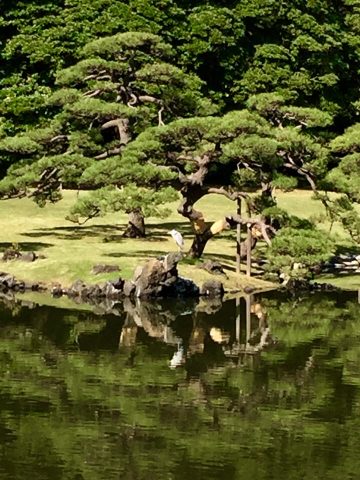
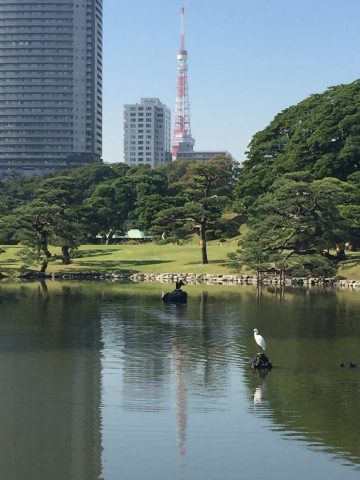
Heron in a Tokyo Park

Heron in a Tokyo Park

HAIKU FOR SAGIMUSUME
A poem by Yuri Kageyama

Dance from white to red
A ghostly bride mirrored in snow
Killed by love, she still lives

I saw Kikunosuke perform the Kabuki dance “Heron Maiden.”
I’ve seen the dance by Tamasaburo many times, but this version was special, perhaps because his subdued though utterly elegant interpretation so perfectly highlighted the beauty of the story and the music, or perhaps just because a garden near where I live, Hamarikyu, has herons.
Now, I know they are so still, perched on a rock with their crooked necks, as though they know but don’t care they are forming a perfect picture for an artist, so intensely focused, ruthless in their silence and stillness.
What a bird it is _ and what an image, forlorn and fantastic at once, to depict the love of a Japanese woman.
It is not necessary to have seen herons every day or be a Japanese woman to appreciate this gorgeous theater piece.
But it helps.
And I thank the god of poetry for giving me the gift that allows me to witness how this great Japanese dance and the humble dignity of the heron can transcend the finitude and pettiness of society.

Heron in a Tokyo Garden.

Heron in a Tokyo Garden.

THE MANY LIVES OF YURI KAGEYAMA _ THE POET IN ME AND THE JOURNALIST IN ME

I get such a nice write-up by Tim Hornyak in No. 1 Shimbun, the publication of the Foreign Correspondents Club of Japan in Tokyo, I can’t believe it is really about me.
It’s called The Many Lives of Yuri Kageyama.
And it brings together the sides of me I usually like to keep separate _ the poet in me and the journalist in me.

“The prose is unvarnished, unflinchingly personal and adroit in quickly juggling themes of child abuse, racism and sexuality while maintaining a narrative flow,” he writes.

“Kageyama’s poems have addressed stereotypes about race and gender roles. They’re made even more powerful when Kageyama recites them with collaborators such as Ghanaian percussionist Winchester Nii Tete on African drums and Keiji Kubo on didgeridoo. Against the backdrop of a traditional Noh stage, it’s a heady, globalized mix of words and music.”

Thanks to Tim. Thanks to all the musicians who have helped my poetry. Thanks to the poets, the literary publishers, the songwriters, the photographers, the filmmakers. Thanks to all the people of Fukushima who have shared their stories with me. Thanks, above all, to all the honorable, creative and dedicated colleagues I have at The Associated Press.

GIFTS FROM THE DEAD a poem by Yuri Kageyama

GIFTS FROM THE DEAD
a poem by Yuri Kageyama

Graves are always There
for those Who are still
Alive to Forgive
Accept Reconcile.
They don’t Speak Back.
They don’t expect much
because
they are ready
to be Forgotten
if not
really already
Forgotten.
So when You
Go There, You
will Be Forgiven:
Grave are Gifts
from the Dead
for the Living.

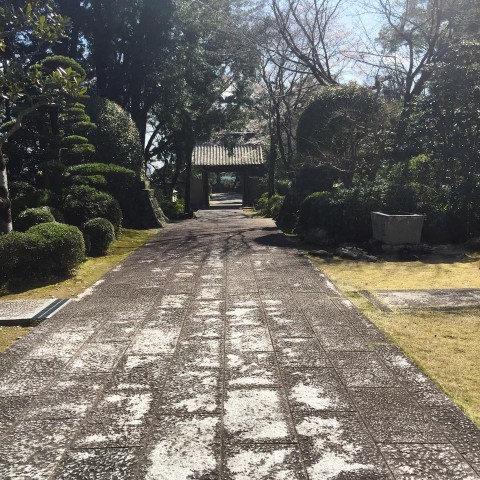
At a temple in Toyokawa, Aichi Prefecture, Japan. Photo by Yuri Kageyama.

At a temple in Toyokawa, Aichi Prefecture, Japan. Photo by Yuri Kageyama.

OH MY BUDDHA _ A poem by Yuri Kageyama with Music composed by Tea and Hiroshi Tokieda

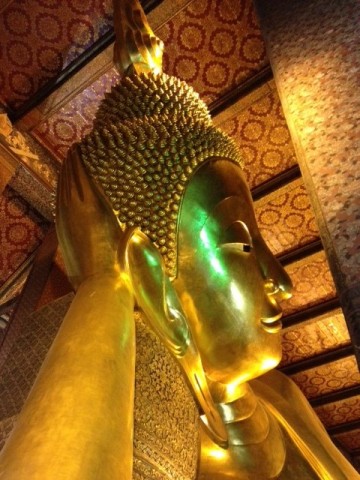
Buddha in Bangkok. Photo by Yuri Kageyama

Buddha in Bangkok. Photo by Yuri Kageyama

OH MY BUDDHA
_ a song about faith, love and other things
By Yuri Kageyama

REPEATING THEME:
My name is Yasodhara
Wife of Buddha
Mother of Rahula
I ride a white elephant
I am Siddharta’s woman

VERSE 1
You took off to find Nirvana
Became a hero for the poor
You just took off one sunny day
And found enlightenment
While I’m stuck in the kitchen
Barefoot and pregnant, alone

(Repeat theme)

VERSE 2
You’ve started a religion
See statues in your likeness
Of gold and bronze and wood
Sitting prim on that lotus
While I’m having your babies
Feeding them, aborting them, alone

(Repeat theme)

VERSE 3
You remember I cooked you breakfast?
So you could go and contemplate
Sitting 49 days under the Bodhi tree
To discover, sacrifice, meditate?
While I’m crying in my misery
Breathing my prayers, alone

(Repeat theme)

REFRAIN
You’re a superstar
I’m a nobody
You live in history
I die unknown
When I awoke
There was no sign of you
When I awoke
There was no sign of you
My universe went up in smoke
Oh, my Buddha
Oh, my Buddha

Sung by Tea Tokieda and Read by Yuri Kageyama.
Music composed by Tea and Hiroshi Tokieda.
Bass by Hiroshi Tokieda, percussions/tabla by Hirokazu Suyama Jackson and shakuhachi by Kouzan Kikuchi.
At Infinity Books AUG 7, 2016, in Tokyo.
Inspired by and dedicated to Toshinori Kondo, who is constantly exploring the meaning of the Asian sound/literarture/self in the world, and told me once that we should all start saying: “Oh My Buddha,” like the way Westerners say: “Oh My God.”
So this is a song about what it would like to be the wife of Buddha _ that behind-every-man-is-a-woman story, and how we women are selfless in love and almost always invisible:

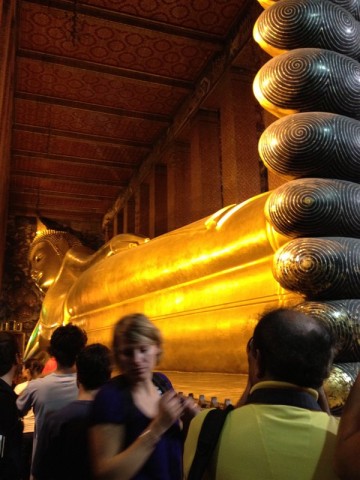
Buddha in Bangkok. Photo by Yuri Kageyama

Buddha in Bangkok. Photo by Yuri Kageyama

Guest in a white room _ A Poem by Yuri Kageyama

Guest in a white room
A Poem by Yuri Kageyama

not unwanted
just invisible
they glide across
smiling like shadows
silent of slurs
silent of praise
you know you are a guest
in a room meant for whites

MY LYRICS FOR A SONG AND MY POEM IN KONCH MAGAZINE

HANDS OF A CLOCK is an R&B song for which I wrote the lyrics for music by Trupti aka Tea and Hiroshi Tokieda _ the same team for I WILL BLEED (featured in the previous post), as well as for “Oh My Buddha.”

HANDS OF A CLOCK is in the January 2016 issue of KONCH magazine, published by Ishmael Reed and edited by Tennessee Reed.

The January 2016 issue of KONCH also published my poem “A Crow’s Request.”

Hands of a Clock
Words by Trupti and Yuri Kageyama
Music by Trupti and Hiroshi Tokieda
Written to be sung by Sybil Thomas in her next album.

Verse 1

Hey, we’ve met before
You say the first night we meet
It feels like a life that’s come around before

Verse 2

Hey, shall we dance?
We’ve met many times in our dreams
I was sure I knew you at first glance

Pre-Chorus

Long before a thing has begun,
We’re tied in a destiny of time
Ticking together as one

Chorus

Like the hands of a clock
We are like the hands of a clock
The world keeps spinning
At every new beginning
We come back around
Like the hands of a clock

Verse 3

Hey, is this reality?
Will this last through the changing times?
‘Coz I am a true believer in eternity

Pre-Chorus

Long before a thing has begun,
We’re tied in a destiny of time
Ticking together as one

Chorus

Like the hands of a clock
We are like the hands of a clock
The world keeps spinning
At every new beginning
We come back around
Like the hands of a clock

Bridge

Seconds Minutes and Hours
Are just ways time stays in a groove
When love has stopped our inner clock
Toward timeless love we will move

I WILL BLEED a song about love that defies all _ a finalist in a UK songwriting contest

I co-wrote the poem/lyrics with Trupti for “I WILL BLEED,” a song about star-crossed lovers inspired by Chikamatsu‘s double-suicides written for Bunraku puppet theater, about how love, no matter how simple, mundane and pathetic, endures, even in death.
The melody was composed by Trupti and Hiroshi Tokieda, who also plays bass in this fine rendition at his father’s Tokyo recording studio (SoundCloud below).
The musical composition by the couple songwriting team was selected a finalist winner in the U.K. Songwriting Contest in December 2015.
I am blessed to be collaborating with and just to know these two young brilliant musicians. I have seen them get married, despite being of different nationalities and backgrounds, tied together so absolutely through their love for music, and their love for each other.
They met at the Berklee College of Music in Boston, where my son Isaku Kageyama graduated recently, and performed together in different musical groups, with both Trupti and Hiroshi.
They are our future, and the future of the best in music.
The best in us. All of us.
What I want to say in this song is that I still believe in love.
I wrote the poem and worked on the song with Trupti, knowing all the while that Trupti would sing it, and that Hiroshi and Trupti would compose the music together.
The song debuted at my poetry reading and tribute to my poet mentor Ishmael Reed at SFJAZZ CENTER in June 2014 (YouTube clip below).
They are the idea for this song.
They are this song.
I created this song for them.

I WILL BLEED
V1
I won’t cry (a)
Coz it’s in love that I bleed (b)
A bridge of ribbon that carries me (b)
Across waves of war no one can see (b)
V2
I won’t run (a)
My blood will rush strong and drain (b)
All my pride, prejudice and pain (b)
Only our love will still remain (b)
C
I will bleed (a)
But I won’t flee,
Hell is what I desire (b)
I will bleed
But I won’t hide
Hell is what I desire
Such heavenly fire
V3
I won’t sleep (a)
Until this ocean turns to wine (b)
On a night when our stars align (b)
Lying cheek to cheek no longer confined (x)
V4
We will live (a)
You the east and me the sun (b)
Not afraid of different tongues (b)
Our blood joined will make us one (x)

Reading excerpts from NEWS FROM FUKUSHIMA

Yuri Kageyama and Hirokazu Suyama Jackson at The Container gallery in Tokyo for a poetry reading. January 2016.

Yuri Kageyama and Hirokazu Suyama Jackson at The Container gallery in Tokyo for a poetry reading. January 2016. Photo by Junji Kurokawa


All Photos by Junji Kurokawa.

Hirokazu Suyama Jackson (tablas) and I did a reading of excerpts from the multi-media performance piece I wrote NEWS FROM FUKUSHIMA: MEDITATION ON AN UNDER-REPORTED CATASTROPHE BY A POET at The Container gallery, which is in a hair salon in Daikanyama, Tokyo.
Thanks to novelist and GLASS magazine writer Peter Yeoh and John Carpenter of the Metropolitan Museum of Art for kindly organizing and having us at the event.

A MOTHER SPEAKS (an excerpt from NEWS FROM FUKUSHIMA)
Poetry by Yuri Kageyama

Please listen and tell the world.
How our children in Fukushima are getting thyroid cancer, one by one.
My daughter is one of them.
Pediatric thyroid cancer is rare.
The chance for getting it is under one in a million.
One in a million.
But in Fukushima, it’s 112 out of 380,000 children tested, and the tally is growing.
This is Fukushima after Three-Eleven.
Beautiful Fukushima, where rice paddies stretch between lazy mountains.
Beautiful Fukushima, where snow falls everywhere like fluffy rice.
Beautiful Fukushima, where, when spring finally comes, cherry trees explode in pink chiffon.
But this is Fukushima after Three-Eleven.
No other place in Japan is like that.
No other place in the world is like that _ except for the Ukraine and Belarus.
But they say these cases are turning up because we are looking so much harder, testing all the children in Fukushima.
The authorities say they are playing it safe.
When no one really feels safe
After Three-Eleven in Fukushima.
My little girl got surgery and so her tumor was removed.
And the doctor told me: Aren’t you so lucky?
Aren’t you so lucky we did those tests to save your child?
If we hadn’t, the cancer might not have been found.
But I don’t feel lucky.
I don’t feel lucky at all.
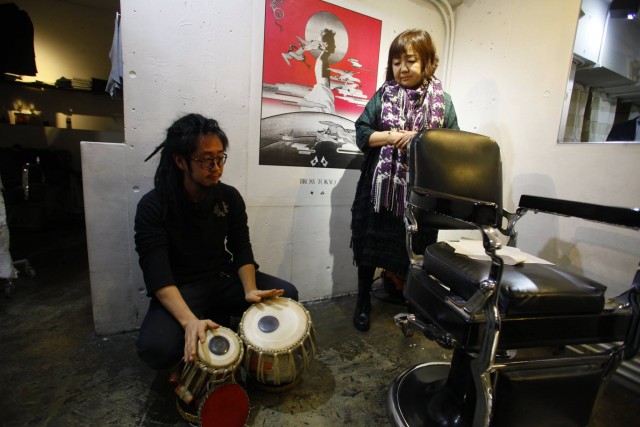
Yuri Kageyama and Hirokazu Suyama Jackson at a Poetry reading in Tokyo

Yuri Kageyama and Hirokazu Suyama Jackson at a Poetry reading in Tokyo

MYTHICAL MONSTER (an excerpt from NEWS FROM FUKUSHIMA)
poetry by Yuri Kageyama

The Catfish sleeps
Buried in the mud
Of meltdown metal
A black-light coastline
Fifty reactors
Tomari to Genkai

The Catfish moves
And the Earth rumbles
Sways its tail
And skyscrapers crumble
Swishes a whisker
Bridges, roads shatter

The Catfish grows
Bigger and bigger
Eight snake faces
Eight dragon tails
Volcanic eruption
Yamata no Orochi

The Monster lives
Our daughters and sons
Every year, a sacrifice
Hundred eight brave samurai
They’re all dead,
Trying to kill it
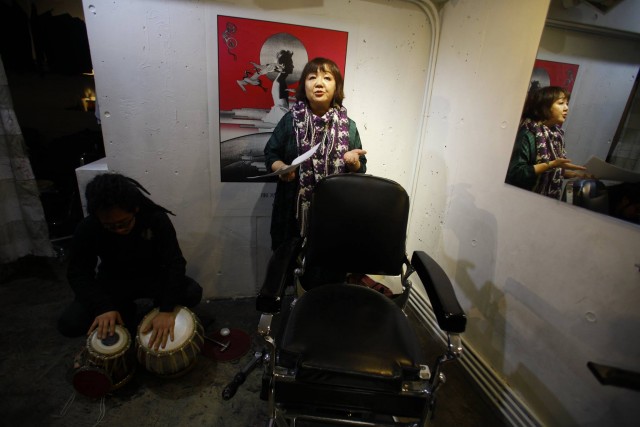
Hirokazu Suyama Jackson and Yuri Kageyamat at a poetry reading in Tokyo

Hirokazu Suyama Jackson and Yuri Kageyamat at a poetry reading in Tokyo