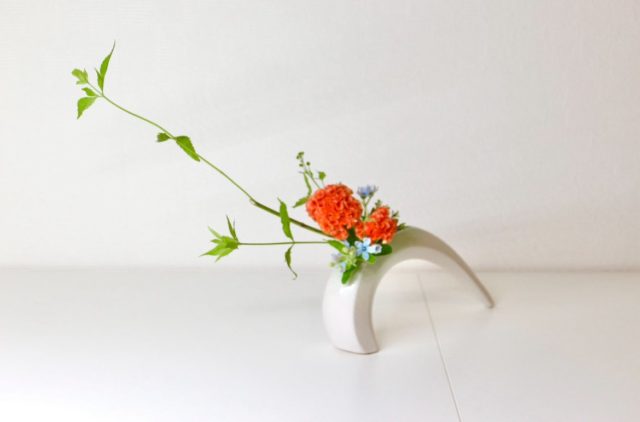
This arrangement has the feel of autumn. The yellow chrysanthemums are the main objects. But the susuki grass blades add dynamism to the composition, while the brown-tinged leaves to the side have their own distinct personality.
My teacher said it was interesting I kept the blades long, and very much like me, which I think he meant in a positive way, as in a free spirit.
I was allowed to choose my vase and so it’s a rather unusual shape this time that really stimulates your imagination as to where the leaves and flowers should be, can be, wants to be, or are speaking to your soul to be. The beauty of Ikebana is that it is a conversation, silent but certain, not only with the elements of Nature but also with things like a vase, specially made by an artist for Ikenobo Ikebana, an individual. You are also relating to many other people, your ikebana teacher, of course, and your inner self, but, more significantly, memories of people, like your mother, who taught you your first lessons in ikebana, pride and joy in your Japanese heritage, and recognizing beauty and the message of impermanence in Life.
The star of today’s ikebana are roses from Kenya called Game Changers, arranged in a wine glass partly filled with plastic crystals. My earlier Ikebana: My first ever Ikenobo Ikebana. Part Two or my Second Attempt. And Part Three.
Two and a half weeks later, the flowers have gone dry but are still vibrant with color. My teacher told me to watch for the flowers as they go dry, and, although I found just three pieces this time, they look grand and happy in the Hagiyaki plate. My parents lived in Yamaguchi Prefecture, where Hagi is located, and my father was a professor after retiring from an engineering company. They became friends with a lot of Hagiyaki artists and got their works at bargain prices. I treasures all their Hagiyaki pieces. There is a whole universe in this arrangement. And the messages that beauty _ and life _ do not end with death.
Hiroshima On Our Minds. Prime Minister Shigeru Ishiba read a tanka poem by Shinoe Shoda at the end of his speech this year. He read it twice, which was not initially planned, saying: “With a flood of emotions as I reflect deeply on those words, I hereby conclude my address.”
The official translation:
The heavy bone must be a teacher’s. The small skulls beside it must be students gathered around.
My translation:
The big bone a teacher
Nearby tiny skulls
Huddle close
The original Japanese:
太き骨は先生ならむ
そのそばに小さきあたまの骨
あつまれり
The words of the Hiroshima poet, who wrote extensively about the horrors of war, are engraved in a memorial in that city. She died in 1965.
People say things have little meaning, and it’s just the person or the emotions that the thing reminds you of that have meaning. Sometimes they are one and the same thing because if you have something for more than 40 years, that certainly means something, and that thing has a meaning of its own. People leave, taking off from this world and going somewhere very far. But the thing stays. And it continues to tell us what that person means. Because that person never really leaves. He is always here, just like, or even more than, that thing. This is the fourth in a series that follows this third piece, which has a link that connects to the previous pieces.
Today’s Ikenobo Ikebana used a sponge called “oasis,” because it’s apparently made by a company called Oasis, to arrange the flowers in a way that was quite three-dimensional but required the placement of the leaves at the bottom to “hide” the sponge. The teacher said to start with the main elements, the sunflowers. You place one sunflower, then the other sunflower, always lower than the first. The other elements are basically fillers for the empty spaces, but you have to think where those spots are and balance them. You can play around with the long leaves, even bending them with your fingers. But always remember the tips must look up, never droop. Adding the water comes last. The speckles of glitter reflecting in the vase are gorgeous and an understatement at once.
Actually my teacher told me it’s against the rules to let a flower that broke off float in the water, when I did it. But when he took the photos at the end of the class with all the lighting set up, or actually another student and me holding them up, he took the flower, dropped it in the water and took this photo. He is a nice teacher. Although allowed in other styles of Ikebana, Ikenobo did not, seeing fallen flowers as death, and his works are about life, purity and our eternal connection to the spiritual. It made me sad that death is so beautiful. And I like this photo.