I get such a nice write-up by Tim Hornyak in No. 1 Shimbun, the publication of the Foreign Correspondents Club of Japan in Tokyo, I can’t believe it is really about me.
It’s called The Many Lives of Yuri Kageyama.
And it brings together the sides of me I usually like to keep separate _ the poet in me and the journalist in me.
“The prose is unvarnished, unflinchingly personal and adroit in quickly juggling themes of child abuse, racism and sexuality while maintaining a narrative flow,” he writes.
“Kageyama’s poems have addressed stereotypes about race and gender roles. They’re made even more powerful when Kageyama recites them with collaborators such as Ghanaian percussionist Winchester Nii Tete on African drums and Keiji Kubo on didgeridoo. Against the backdrop of a traditional Noh stage, it’s a heady, globalized mix of words and music.”
Thanks to Tim. Thanks to all the musicians who have helped my poetry. Thanks to the poets, the literary publishers, the songwriters, the photographers, the filmmakers. Thanks to all the people of Fukushima who have shared their stories with me. Thanks, above all, to all the honorable, creative and dedicated colleagues I have at The Associated Press.
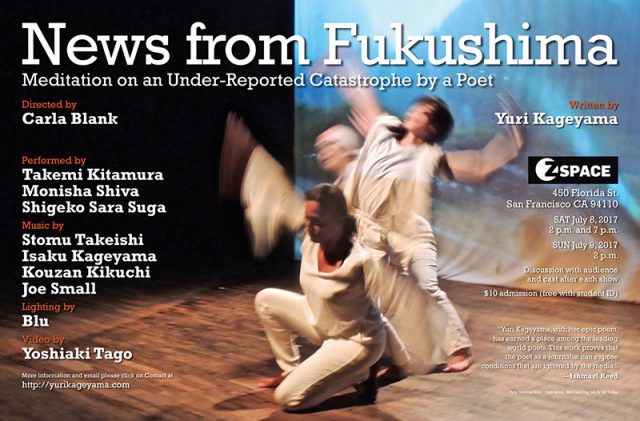
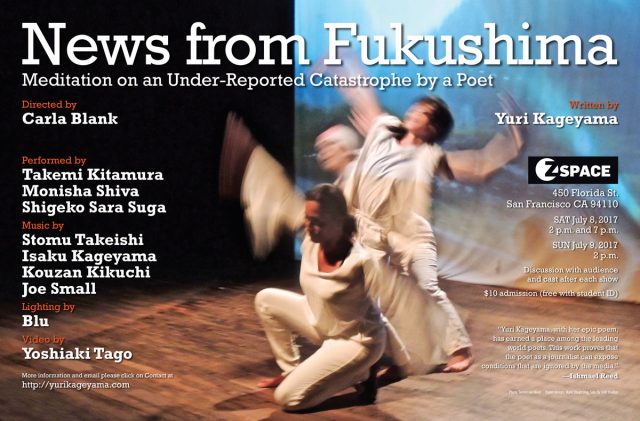
NEWS FROM FUKUSHIMA: Meditation on an Under-Reported Catastrophe by a Poet
NEWS FROM FUKUSHIMA
Meditation on an Under-Reported Catastrophe by a Poet
Written by Yuri Kageyama | Directed by Carla Blank Z Space 450 Florida St. San Francisco CA 94110
SAT July 8, 2017 2 p.m. and 7 p.m.
SUN July 9, 2017 2 p.m.
$10 admission (free with student ID)
Discussion with audience and cast after each show.
For tickets and other information, please click on this special Z space site.
“Yuri Kageyama, with her epic poem, has earned a place among the leading world poets. This work proves that the poet as a journalist can expose conditions that are ignored by the media.” _ Ishmael Reed
“A commentary on what it means to be human in the 21st Century.” _ Basir Mchawi
“A beacon of light in a darkening world.” _ Paul Armstrong
“Tough yet faithful production and its dedication to truth-telling.” _ David Henderson
“The nuclear age of post-World War II Japan has never ended.” _ Hisami Kuroiwa
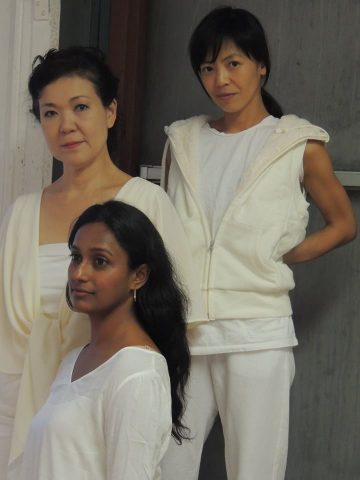
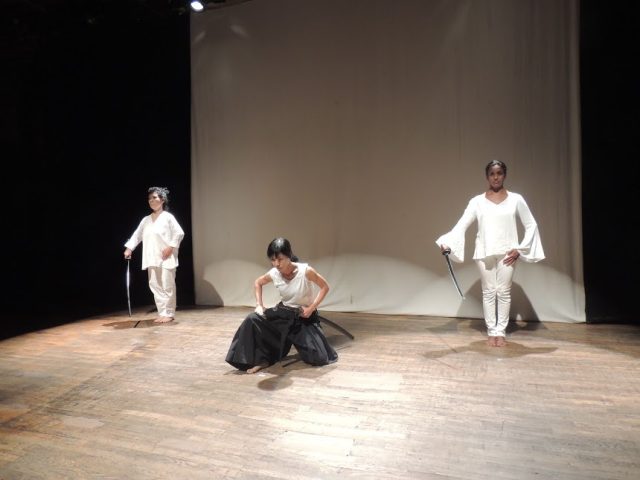
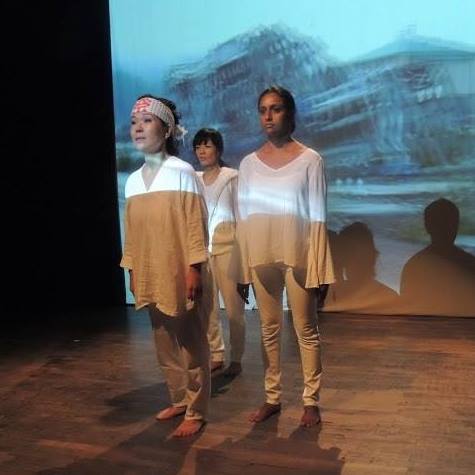
The performers in NEWS FROM FUKUSHIMA: From left to right: Shigeko Sara Suga, Monisha Shiva, Takemi Kitamura (photo by Tennessee Reed)
Fukushima is the worst nuclear disaster since Chernobyl. It will take decades and billions of dollars to keep the multiple meltdowns under control. Spewed radiation has reached as far as the American West Coast. Some 100,000 people were displaced from the no-go zone. But, six years after 3.11, the story hardly makes headlines.
Journalist Yuri Kageyama turns to poetry, dance, theater, music and film, to remind us that the human stories must not be forgotten. Carla Blank, who has directed plays in Xiangtan and Ramallah, as well as collaborated with Suzushi Hanayagi and Robert Wilson, brings together a multicultural cast of artists to create provocative theater. Performing as collaborators are actors/dancers Takemi Kitamura, Monisha Shiva, Shigeko Sara Suga and musicians Stomu Takeishi, Isaku Kageyama, Kouzan Kikuchi and Joe Small. Lighting design by Blu. Documentary video of Fukushima by Yoshiaki Tago.
NEWS FROM FUKUSHIMA is a literary prayer for Japan. It explores the friendship between women, juxtaposing the intimately personal with the catastrophic. The piece, which had a debut run at La MaMa in New York in 2015, continues to develop and premieres on the West Coast at Z Space in San Francisco.
For more information, interviews and other queries:
Please click on Contact
BIOS OF THE ARTISTS: THE PLAYWRIGHT
Yuri Kageyama. Photo by Junji Kurokawa.
YURI KAGEYAMA is an award-winning journalist, poet, songwriter, filmmaker and author of “The New and Selected Yuri” and “The Very Special Day.” Her spoken-word band the Yuricane has featured Melvin Gibbs, Eric Kamau Gravatt, Morgan Fisher, Pheeroan akLaff and Winchester Nii Tete. She is published in ”Breaking Silence,” “On a Bed of Rice,” “Pow Wow,” Cultural Weekly, Y’Bird, Konch and Public Poetry Series. http://yurikageyama.com/
THE DIRECTOR
Carla Blank
CARLA BLANK is a writer, editor, director, dramaturge and a teacher and performer of dance and theater for more than 50 years. She worked with Robert Wilson to create “KOOL _Dancing in My Mind,” inspired by Japanese choreographer Suzushi Hanayagi. She directed Wajahat Ali’s “The Domestic Crusaders” from a restaurant reading in Newark, California, to Off Broadway and the Kennedy Center. http://www.carlablank.com/bio.htm
THE ACTORS
TAKEMI KITAMURA, choreographer, dancer, puppeteer, Japanese sword fighter and actor, appeared in “The Oldest Boy” at Lincoln Center, “The Indian Queen” directed by Peter Sellars; “Shank’s Mare” by Tom Lee and Koryu Nishikawa V; “Demolishing Everything with Amazing Speed” by Dan Hurlin and “Memory Rings” by Phantom Limb Co. She has worked with Nami Yamamoto, Sondra Loring and Sally Silvers. http://takemikitamura.com/
TAKEMI KITAMURA (CENTER). PHOTO BY TENNESSEE REED.
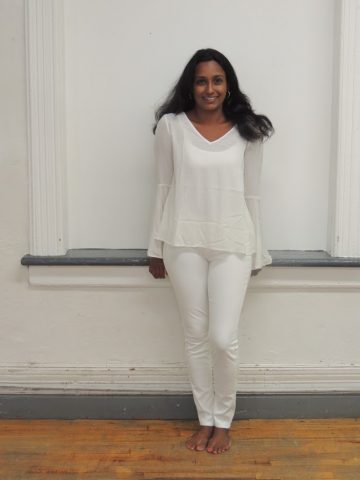
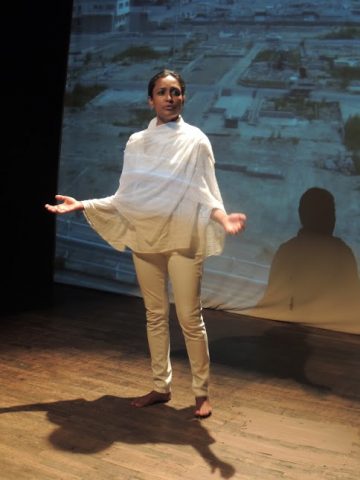
MONISHA SHIVA. PHOTO BY TENNESSEE REED.
MONISHA SHIVA is an actor, dancer, choreographer and painter, appearing in “The Domestic Crusaders” and “The Rats,” for theater, and independent films such as “Small Delights,” “Carroll Park,” “Echoes” and “Ukkiya Jeevan.” A native New Yorker, she has studied classical Indian dance and Bollywood, jazz and samba dancing, and acting at William Esper Studios and Studio 5. http://www.monishashiva.com/Monisha/home.html
SHIGEKO SUGA (LEFT). PHOTO BY TENNESSEE REED.
SHIGEKO SARA SUGA, actress, director, artistic associate at La MaMa Experimental Theatre Club, and Flamenco and Butoh dancer, has performed in 150 productions, including Pan Asian Rep.’s “Shogun Macbeth” and “No No Boy.” She dedicates her performance to her nephew Ryoei Suga, who volunteered in Kesennuma after the 2011 tsunami and now devotes his life there as a fisherman and monk. www.shigekosuga.com
THE MUSICIANS
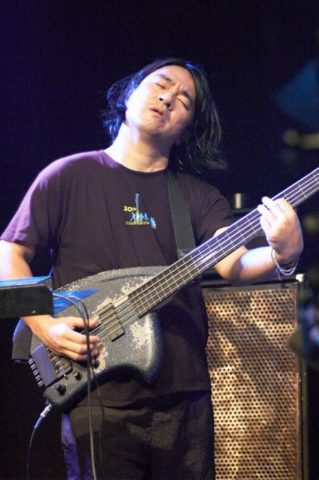
STOMU TAKEISHI is a master of the fretless electric bass and has played and recorded in a variety of jazz settings with artists such as Henry Threadgill, Brandon Ross, Myra Melford, Don Cherry, Randy Brecker, Satoko Fujii, Dave Liebman, Cuong Vu, Paul Motian and Pat Metheny. He tours worldwide and performs at various international jazz festivals.
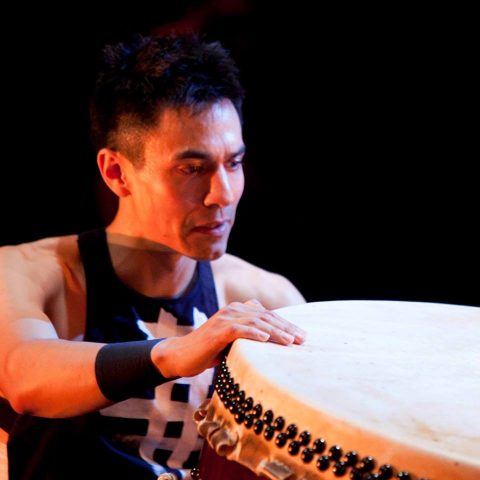
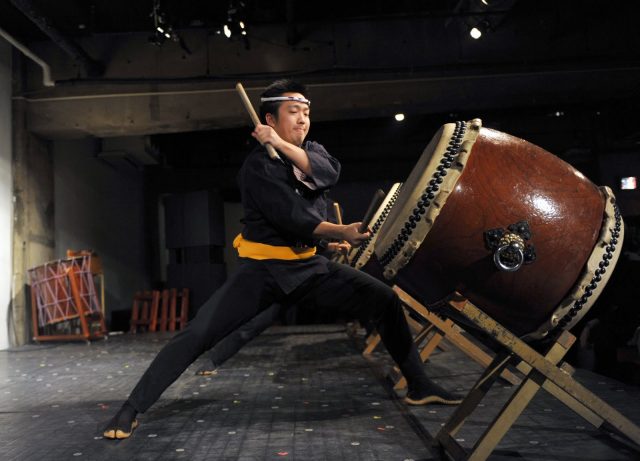
ISAKU KAGEYAMA. PHOTO BY KOJI SASAHARA.
ISAKU KAGEYAMA is a taiko drummer and percussionist, working with Asano Taiko UnitOne in Los Angeles, film-scoring extravaganza “The Masterpiece Experience” and Tokyo ensemble Amanojaku. A magna cum laude Berklee College of Music graduate, he teaches at Wellesley, University of Connecticut and Brown. http://isakukageyama.com/
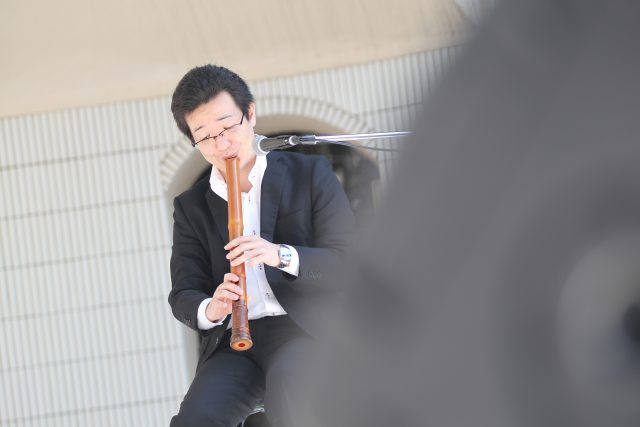
KOUZAN KIKUCHI. PHOTO BY JUNJI KUROKAWA.
KOUZAN KIKUCHI, shakuhachi player from Fukushima, studied minyo shamisen with his mother. A graduate of the Tokyo University of the Arts, he studied with National Treasure Houzan Yamamoto. He has worked with Ebizo Ichikawa, Shinobu Terajima and Motoko Ishii. In 2011, he became Tozanryu Shakuhachi Foundation “shihan” with highest honors.
JOE SMALL is a taiko artist, who is a member of Eitetsu Hayashi’s Fu-un no Kai and creator of the original concert, “Spall Fragments.” A Swarthmore graduate, he apprenticed for two years with Kodo, researched Japanese music as a Fulbright Fellow and holds an MFA in Dance from UCLA. He teaches at the Los Angeles Taiko Institute. www.joesmalltaiko.com
THE LIGHTING DESIGNER
BLU lived in New York for 20 years and was resident designer at the Cubiculo and La MaMa Experimental Theatre Club. A Bessie Award winner, he was lighting designer for renowned dance theater artists such as Sally Gross, Eiko and Koma, Ping Chong, Donald Byrd, Nancy Meehan and Paula Josa Jones.
THE FILMMAKER
YOSHIAKI TAGO
YOSHIAKI TAGO directed “A.F.O.,” “Believer,” “Worst Contact,” “Meido in Akihabara.” His short “The Song of a Tube Manufacturer” won the runner-up prize at the Yasujiro Ozu Memorial Film Festival in 2013. He serves as film adviser for Takashi Murakami. He has worked with Nobuhiko Obayashi, Takashi Miike and Macoto Tezuka. He is documenting “News from Fukushima” as a film.
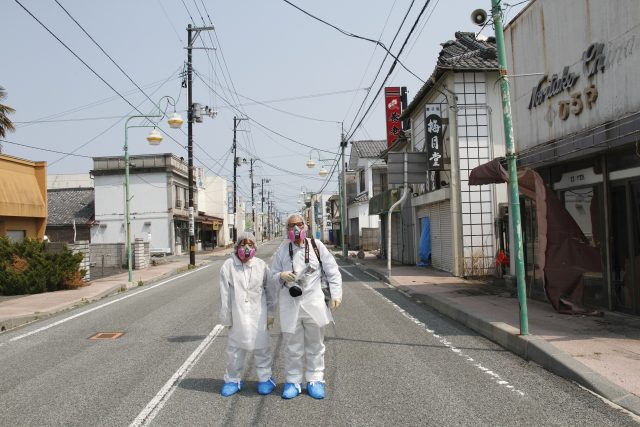
Yuri Kageyama reports with a photographer in the Fukushima no-go zone. Photo by Kazuhiro Onuki.
What people are saying about NEWS FROM FUKUSHIMA: MEDITATION ON AN UNDER-REPORTED CATASTROPHE BY A POET.
Yuri Kageyama, with her epic poem, has earned a place among the leading world poets. This work proves that the poet as a journalist can expose conditions that are ignored by the media. _ Ishmael Reedpoet, essayist, playwright, publisher, lyricist, author of MUMBO JUMBO, THE LAST DAYS OF LOUISIANA RED and THE COMPLETE MUHAMMAD ALI, MacArthur Fellowship, professor at the University of California Berkeley, San Francisco Jazz Poet Laureate (2012-2016).
NEWS FROM FUKUSHIMA is a commentary on what it means to be human in the 21st Century. While we are divided by race, ethnicity, language, geography and culture, the essence of our humanity remains constant. In NEWS FROM FUKUSHIMA, the cast, director and playwright all come together to create a montage of courage, uncertainty and hope in the face of disaster. _ Basir Mchawi producer, community organizer and radio show host at WBAI Radio in New York, who has taught at the City University of New York, public schools and independent Black schools.
A truly emotional experience. _ Liliana Perezchild psychologist and Ph.D.
A vital story of our times. Spoken word and music from a talented multicultural ensemble. A beacon of light in a darkening world. _ Paul Armstrongartistic director at International Arts Initiatives, a Vancouver-based nonprofit for cultural advancement through the arts and education.
I welcomed NEWS FROM FUKUSHIMA _ into my consciousness, with deep gratitude, seeing it twice, two days in succession _ all the while marveling at the tough yet faithful production and its dedication to truth-telling. _ David Hendersonpoet, co-founder of Umbra and the Black Arts Movement, author of ‘SCUSE ME WHILE I KISS THE SKY. JIMI HEDNRIX: VOODOO CHILD.
Tragically, Fukushima is still constantly being shaken by earthquakes. NEWS FROM FUKUSHIMA echoes the mourning of Bon Odori dance to warn us again and again that the nuclear age of post-World War II Japan has never ended. _ Hisami Kuroiwamovie producer and executive for “The Shell Collector,” “”Lafcadio Hearn: His Journey to Ithaca,” “Sunday,” “Bent” and the Silver Bear-winning “Smoke.”
Fukushima: Excellent musical accompaniment to poignant poetry, with minimal yet imaginative staging and choreography. Musicians were absolutely superb! _ Nana pianist and New Yorker.
What a delight was the new theater piece featuring Shigeko Suga, which did a short run at La MaMa. Ms. Suga and her fellow performers glided beautifully with wit, authority and grace through the stylized performances. See this show and be transported magically. _ George Ferencz co-founder of the Impossible Ragtime Theater, resident director at La MaMa (1982-2008), who has also directed at the Actors’ Theater of Louisville, Berkeley Rep and Cleveland Playhouse.
News that enraptures and engages through Sound. A Poet sings of the unreported calamity at Fukushima in NEWS FROM FUKUSHIMA to Melvin Gibbs’ bass. _ Katsumia Japanese living in New York.
It spoke of what’s most critically needed in this age. Despite advances in civilization and culture, the power of emotions has weakened, and people don’t know how to talk to each other. Everyone who took part in this performance, and those who came to see it, although of different races and thinking, all felt clearly the existence of what we know is so important, what we feel is so needed: Love. Love is not an abstract concept. It is about how we treasure our family, how we treat our lovers, our friends. I have lived to see many people who hurt others out of selfishness, betrayed others without qualms, and then went on to hide what they had done. But in the end, what is desired is not achieved, leaving only hunger, and, because of that, the cycle gets repeated again. What I saw here is not just cultural collaboration but what is at the center of that _ a warm feeling, and the expression of the message that the world cannot go on this way. I pray more people will be able to feel love through seeing this performance. I pray as someone who believes in love. _ Toshinori “Toshichael Jackson” Tani dancer, member of TL Brothers and instructor.
An excerpt from NEWS FROM FUKUSHIMA: “Hiroshima.” Filmed and edited by Yuri Kageyama.
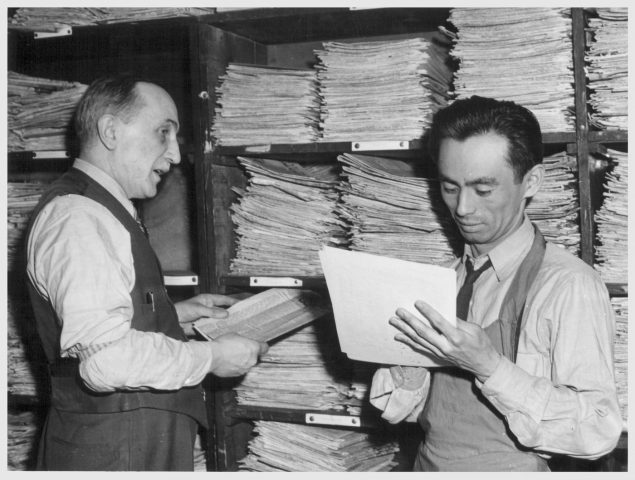
Joe Oyama in an Online California Archives photo, as he stands in the New York headquarters of the Common Council for American Unity. Joe was assistant editor of the Japanese American daily in Los Angeles before he was interned, in Santa Anita Assembly Center and Jerome Relocation Center, where both he and his wife Sami worked as journalists. After moving to New York in 1944, he was editor of the News Letter of the Japanese American Committee for Democracy. He and his wife were also both actors. They moved to Berkeley in their later years. I got to know him and Sami and their two children, who are also great artists. Joe was always supportive of my poetry: “Like champagne,” he said once. This poem is for Joe and all the other great journalists. May the legacy live on.
A Poem for Journalism
By Yuri Kageyama
A Tree, a Story, a Drum
Circles carved times over,
Coded rhythms of continents
Animal skin stretched, carefully nailed,
So our heartbeat is not lost _
The snare, congas, kpanlogo, tabla, taiko,
Talking drums speaking faraway tongues _
Stories killed, stories buried,
Stories denied, stories untold,
Perhaps we were just not stopped before
When our stories were not dangerous
But the Reporter is still here.
Hear the words
And see what they have seen:
Robert and Dori Maynard
Woodward and Bernstein
Margaret Bourke-White
Howard Imazeki
Gary Webb
Robert Capa
Anja Niedringhaus
Gerald Vizenor
Gwen Ifill
Joe Oyama
Gordon Parks
Hear that Music in the Skin,
Feel that Story in the Tree,
Banned by slave owners,
The Drum holds the Message,
The Pow Wow stirs in starlit nights
The Slap-Tone conviction that comes to us
The Dance cannot be silenced; listen:
Printers rumble, digital pages scroll, newspapers turn,
Borders fade into illusory walls,
Starving children, covered up documents, the ravages of war
The Voice through the centuries
Asking Questions
Even if no one cares to hear the Answers,
Accurate, objective, fast, ethical
No matter what they say,
I am deranged but I am not deranged
I am fake but I am not fake
I am afraid but I am not afraid
I am the Drum, the Tree, the Story.
shrieks growls wails moaning jagged cries that tell stories of the urban jungle wire and metal untamed animal half machine bleeding real blood never stops a never-ending pulse guerilla warfare of free music of onomatopoeia like a snake or a frog whose skin is always wet
Graves are always There
for those Who are still
Alive to Forgive
Accept Reconcile.
They don’t Speak Back.
They don’t expect much
because
they are ready
to be Forgotten
if not
really already
Forgotten.
So when You
Go There, You
will Be Forgiven:
Grave are Gifts
from the Dead
for the Living.
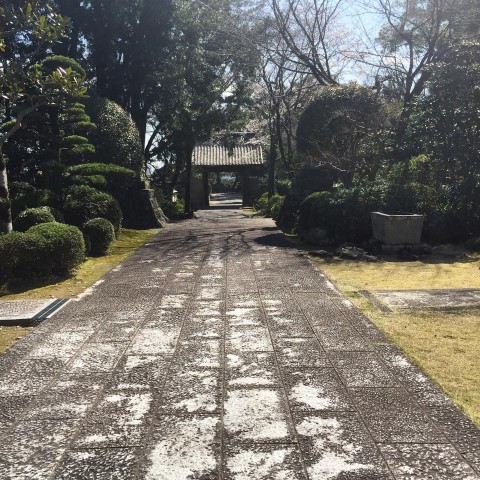
At a temple in Toyokawa, Aichi Prefecture, Japan. Photo by Yuri Kageyama.
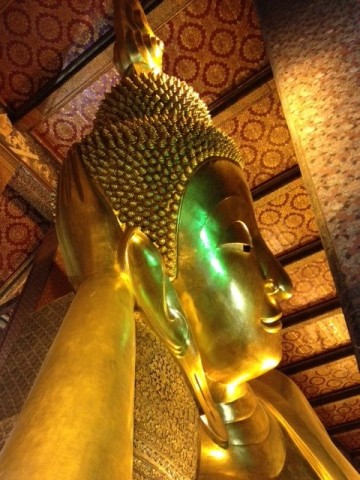
OH MY BUDDHA
_ a song about faith, love and other things
By Yuri Kageyama
REPEATING THEME:
My name is Yasodhara
Wife of Buddha
Mother of Rahula
I ride a white elephant
I am Siddharta’s woman
VERSE 1
You took off to find Nirvana
Became a hero for the poor
You just took off one sunny day
And found enlightenment
While I’m stuck in the kitchen
Barefoot and pregnant, alone
(Repeat theme)
VERSE 2
You’ve started a religion
See statues in your likeness
Of gold and bronze and wood
Sitting prim on that lotus
While I’m having your babies
Feeding them, aborting them, alone
(Repeat theme)
VERSE 3
You remember I cooked you breakfast?
So you could go and contemplate
Sitting 49 days under the Bodhi tree
To discover, sacrifice, meditate?
While I’m crying in my misery
Breathing my prayers, alone
(Repeat theme)
REFRAIN
You’re a superstar
I’m a nobody
You live in history
I die unknown
When I awoke
There was no sign of you
When I awoke
There was no sign of you
My universe went up in smoke
My universe went up in smoke
Oh, my Buddha
Oh, my Buddha
Sung by Tea Tokieda and Read by Yuri Kageyama.
Music composed by Tea and Hiroshi Tokieda.
Bass by Hiroshi Tokieda, percussions/tabla by Hirokazu Suyama Jackson and shakuhachi by Kouzan Kikuchi.
At Infinity Books AUG 7, 2016, in Tokyo.
Inspired by and dedicated to Toshinori Kondo, who is constantly exploring the meaning of the Asian sound/literarture/self in the world, and told me once that we should all start saying: “Oh My Buddha,” like the way Westerners say: “Oh My God.”
So this is a song about what it would like to be the wife of Buddha _ that behind-every-man-is-a-woman story, and how we women are selfless in love and almost always invisible:
not unwanted
just invisible
they glide across
smiling like shadows
silent of slurs
silent of praise
you know you are a guest
in a room meant for whites
Hands of a Clock
Words by Trupti and Yuri Kageyama
Music by Trupti and Hiroshi Tokieda
Written to be sung by Sybil Thomas in her next album.
Verse 1
Hey, we’ve met before
You say the first night we meet
It feels like a life that’s come around before
Verse 2
Hey, shall we dance?
We’ve met many times in our dreams
I was sure I knew you at first glance
Pre-Chorus
Long before a thing has begun,
We’re tied in a destiny of time
Ticking together as one
Chorus
Like the hands of a clock
We are like the hands of a clock
The world keeps spinning
At every new beginning
We come back around
Like the hands of a clock
Verse 3
Hey, is this reality?
Will this last through the changing times?
‘Coz I am a true believer in eternity
Pre-Chorus
Long before a thing has begun,
We’re tied in a destiny of time
Ticking together as one
Chorus
Like the hands of a clock
We are like the hands of a clock
The world keeps spinning
At every new beginning
We come back around
Like the hands of a clock
Bridge
Seconds Minutes and Hours
Are just ways time stays in a groove
When love has stopped our inner clock
Toward timeless love we will move
I co-wrote the poem/lyrics with Trupti for “I WILL BLEED,” a song about star-crossed lovers inspired by Chikamatsu‘s double-suicides written for Bunraku puppet theater, about how love, no matter how simple, mundane and pathetic, endures, even in death.
The melody was composed by Trupti and Hiroshi Tokieda, who also plays bass in this fine rendition at his father’s Tokyo recording studio (SoundCloud below).
The musical composition by the couple songwriting team was selected a finalist winner in the U.K. Songwriting Contest in December 2015.
I am blessed to be collaborating with and just to know these two young brilliant musicians. I have seen them get married, despite being of different nationalities and backgrounds, tied together so absolutely through their love for music, and their love for each other.
They met at the Berklee College of Music in Boston, where my son Isaku Kageyama graduated recently, and performed together in different musical groups, with both Trupti and Hiroshi.
They are our future, and the future of the best in music.
The best in us. All of us.
What I want to say in this song is that I still believe in love.
I wrote the poem and worked on the song with Trupti, knowing all the while that Trupti would sing it, and that Hiroshi and Trupti would compose the music together.
The song debuted at my poetry reading and tribute to my poet mentor Ishmael Reed at SFJAZZ CENTER in June 2014 (YouTube clip below).
They are the idea for this song.
They are this song.
I created this song for them.
I WILL BLEED
V1
I won’t cry (a)
Coz it’s in love that I bleed (b)
A bridge of ribbon that carries me (b)
Across waves of war no one can see (b)
V2
I won’t run (a)
My blood will rush strong and drain (b)
All my pride, prejudice and pain (b)
Only our love will still remain (b)
C
I will bleed (a)
But I won’t flee,
Hell is what I desire (b)
I will bleed
But I won’t hide
Hell is what I desire
Such heavenly fire
V3
I won’t sleep (a)
Until this ocean turns to wine (b)
On a night when our stars align (b)
Lying cheek to cheek no longer confined (x)
V4
We will live (a)
You the east and me the sun (b)
Not afraid of different tongues (b)
Our blood joined will make us one (x)
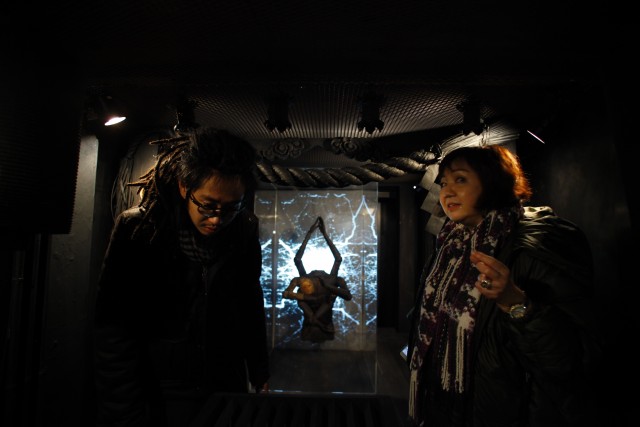
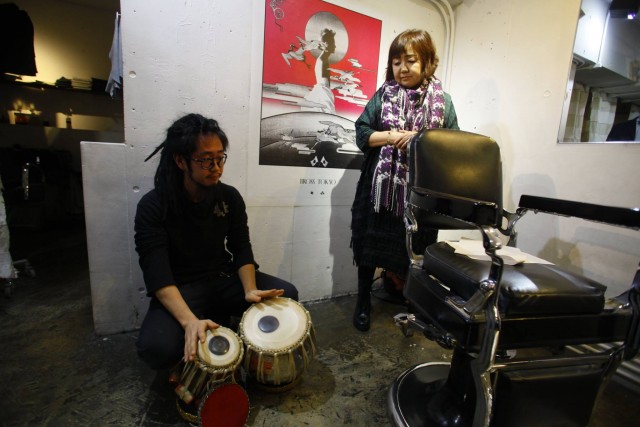
Yuri Kageyama and Hirokazu Suyama Jackson at The Container gallery in Tokyo for a poetry reading. January 2016. Photo by Junji Kurokawa
All Photos by Junji Kurokawa.
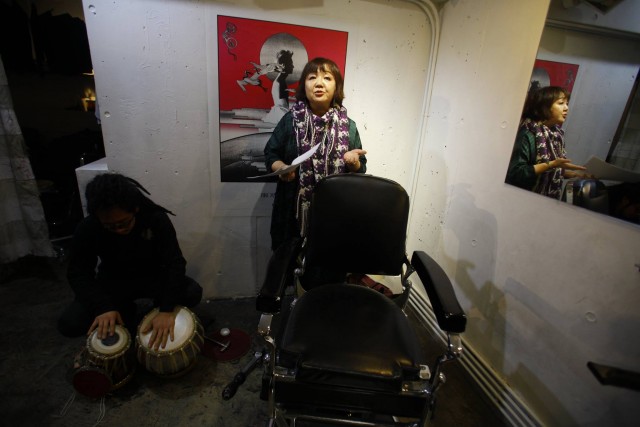
Hirokazu Suyama Jackson (tablas) and I did a reading of excerpts from the multi-media performance piece I wrote NEWS FROM FUKUSHIMA: MEDITATION ON AN UNDER-REPORTED CATASTROPHE BY A POET at The Container gallery, which is in a hair salon in Daikanyama, Tokyo.
Thanks to novelist and GLASS magazine writer Peter Yeoh and John Carpenter of the Metropolitan Museum of Art for kindly organizing and having us at the event.
A MOTHER SPEAKS (an excerpt from NEWS FROM FUKUSHIMA)
Poetry by Yuri Kageyama
Please listen and tell the world.
How our children in Fukushima are getting thyroid cancer, one by one.
My daughter is one of them.
Pediatric thyroid cancer is rare.
The chance for getting it is under one in a million.
One in a million.
But in Fukushima, it’s 112 out of 380,000 children tested, and the tally is growing.
This is Fukushima after Three-Eleven.
Beautiful Fukushima, where rice paddies stretch between lazy mountains.
Beautiful Fukushima, where snow falls everywhere like fluffy rice.
Beautiful Fukushima, where, when spring finally comes, cherry trees explode in pink chiffon.
But this is Fukushima after Three-Eleven.
No other place in Japan is like that.
No other place in the world is like that _ except for the Ukraine and Belarus.
But they say these cases are turning up because we are looking so much harder, testing all the children in Fukushima.
The authorities say they are playing it safe.
When no one really feels safe
After Three-Eleven in Fukushima.
My little girl got surgery and so her tumor was removed.
And the doctor told me: Aren’t you so lucky?
Aren’t you so lucky we did those tests to save your child?
If we hadn’t, the cancer might not have been found.
But I don’t feel lucky.
I don’t feel lucky at all.
Yuri Kageyama and Hirokazu Suyama Jackson at a Poetry reading in Tokyo
MYTHICAL MONSTER (an excerpt from NEWS FROM FUKUSHIMA)
poetry by Yuri Kageyama
The Catfish sleeps
Buried in the mud
Of meltdown metal
A black-light coastline
Fifty reactors
Tomari to Genkai
The Catfish moves
And the Earth rumbles
Sways its tail
And skyscrapers crumble
Swishes a whisker
Bridges, roads shatter
The Catfish grows
Bigger and bigger
Eight snake faces
Eight dragon tails
Volcanic eruption
Yamata no Orochi
The Monster lives
Our daughters and sons
Every year, a sacrifice
Hundred eight brave samurai
They’re all dead,
Trying to kill it
Hirokazu Suyama Jackson and Yuri Kageyamat at a poetry reading in Tokyo
 ISAKU KAGEYAMA. PHOTO BY KOJI SASAHARA.