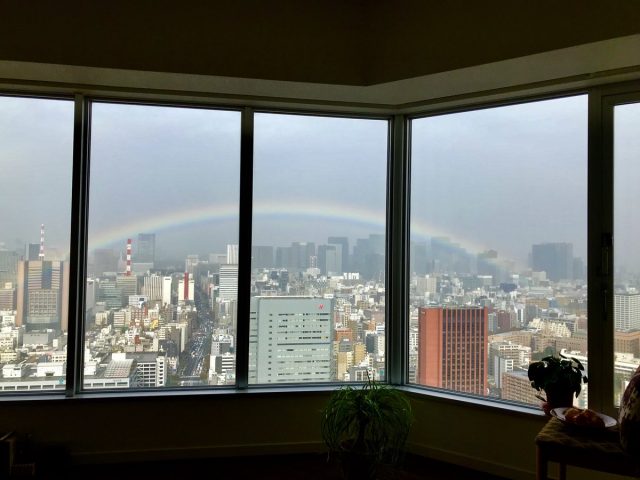
HAIKU
by Yuri Kageyama
にじひかる
ウラの空き地の
スピリンクラー
🌈🌈🌈🌈🌈
🌈🌈🌈🌈🌈🌈🌈
🌈🌈🌈🌈🌈
A rainbow gleams
In the empty backyard lot
A sprinkler is on
🌈🌈🌈🌈🌈
🌈🌈🌈🌈🌈🌈🌈
🌈🌈🌈🌈🌈
HAIKU
by Yuri Kageyama
にじひかる
ウラの空き地の
スピリンクラー
🌈🌈🌈🌈🌈
🌈🌈🌈🌈🌈🌈🌈
🌈🌈🌈🌈🌈
A rainbow gleams
In the empty backyard lot
A sprinkler is on
🌈🌈🌈🌈🌈
🌈🌈🌈🌈🌈🌈🌈
🌈🌈🌈🌈🌈
HAIKU FOR FILMMAKING
by Yuri Kageyama
映画ははかない
映画はすごい嘘
映画はすばらしい
Movies are lost souls
Movies are lies and how
Wondrous are movies
AN ODE TO THE ASIAN UNCLE TOM _ a poem By Yuri Kageyama
NOW PUBLISHED IN THE SUMMER 2018 ISSUE OF KONCH edited and published by Ishmael Reed and Tennessee Reed.
An ode to the Asian Uncle Tom
A Yuricane poem (or does power always turn evil?)
by Yuri Kageyama
You sit prim with your glasses
Behind that desk, title, resume
Won on the backs of
The 442 Purple Hearts
Oblivious in your banal Banana-ism
To the fact that
Yellow is your Color
The most expedient, forgotten,
Cheapest of lives
Hiroshima
My Lai
North Korea
You sip white wine at ethnic restaurants
New York, Tokyo, Dubai, Bangkok
They all look alike
Smiling in Instagram posts
You have it made
You have them duped
You have arrived
Never mind, in your deepest fearful solitary moments,
You can’t help but pick out
Just those
Who look like you:
Race suddenly a Reality;
You must put them down,
And make sure they stay down,
Remain the invisible man, the invisible woman,
Establish as Fact through rumors and appraisals
That People of Color
Can’t be objective, and, be careful,
Get easily used,
You can do the math _ as the stereotype goes _
The slots are limited,
Tokenism being a zero sum game,
Diversity cannot be the majority;
You’ve long lost your ancestral accent
You’ve adopted the air of leaders
You’ve deleted memories
Of how we were all shackled,
We picked strawberries,
We built the Transcontinental Railroad,
We survived behind barbed wires,
Instead
You go to meetings,
Rehearse video appearances,
Take vacations to the Caribbean and Bali,
Sneer at Chinese going shopping,
Plan your retirement,
Asian American
Only to whites
Our collaboration at Space M in Tokyo May 22, 2018.
The visual artists live painting: Munenori Tamagawa and Radio the Artist.
Hirokazu “Jackson” Suyama on Handpan
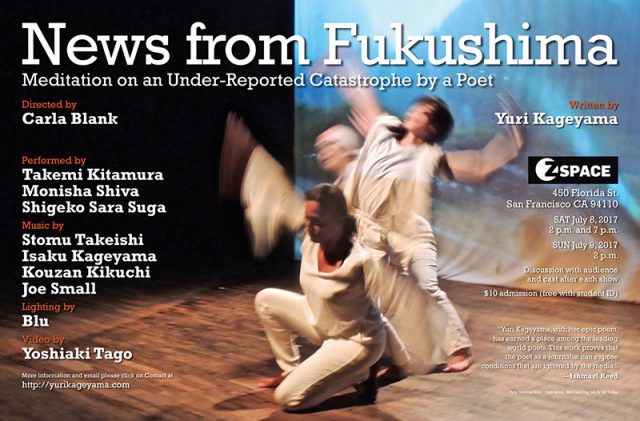
My Poetry read with rattles by yours truly “Mythical Monster” and “Hip Hop Fukushima,” both excerpts from my theater piece NEWS FROM FUKUSHIMA: MEDITATION ON AN UNDER-REPORTED CATASTROPHE BY A POET, which debuted at La Mama in New York in 2015, where Hiro also played the drum set and percussion. It was also performed last year in San Francisco Z Space.
Thanks to Kenji Taguchi for the video and for having our poetry at this fabulous showcasing of important visual artists.
MYTHICAL MONSTER
by Yuri Kageyama
The Catfish sleeps
Buried in the mud
Of meltdown metal
A black-light coastline
Fifty reactors
Tomari to Genkai
The Catfish moves
And the Earth rumbles
Sways its tail
And skyscrapers crumble
Swishes a whisker
Bridges, roads shatter
The Catfish grows
Bigger and bigger
Eight snake faces
Eight dragon tails
Volcanic eruption
Yamata no Orochi
The Monster lives
Our daughters and sons
Every year, a sacrifice
Hundred eight brave samurai
They’re all dead,
Trying to kill it
HIP HOP FUKUSHIMA
by Yuri Kageyama
Y’all, it’s a Meltdown nation
Since Three-Eleven
Covered in the fear
Of unseen radiation
But don’t you expect
Any revolution
All you will find
Is fear and contamination.
Here in Fukushima
It rhymes with Hiroshima
Instead of a holler
Hear just a whimper
They say it is safe
The kids like Chernobyl
Are coming down sick
With Thyroid cancer.
Fukushima
Fukushima
Fukushima
Y’all, it’s no hallucination
The refugees’ life
No compensation
No resolution
Just nuclear explosions
Get your dosimeter
Cesium in the water
Lost Imagination
Here in Fukushima
It rhymes with Hiroshima
The radiated Brothers
Faces are hidden
Goggles and masks
Like an astronaut
From head to toe
The Invisible workers
Fukushima
Fukushima
Fukushima
Premature aging
Nerve cells dying
Sterility, deformity
Unborn baby
Blood count dissipation
Leukemia debilitation
DNA radiation
Godzilla’s affliction
Tsunami Demolition
God’s DeCreation
Genetic Devastation
Our next Generation.
Here in Fukushima
It rhymes with Hiroshima
No-go zones forever
The World must remember.
Fukushima
Fukushima
Fukushima
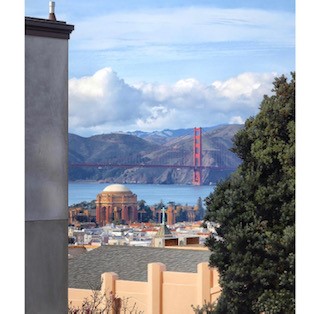
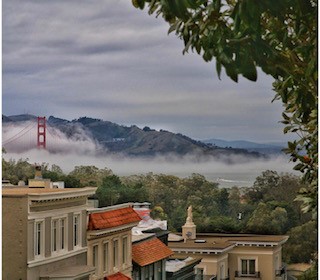
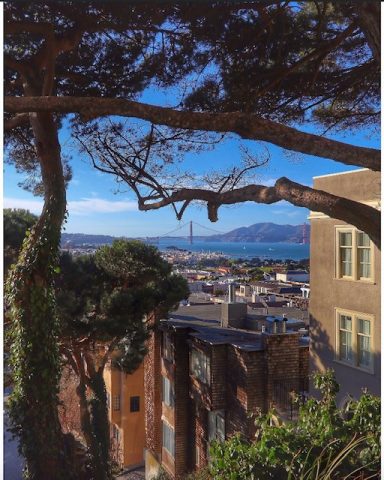
Photos of San Francisco by Annette Borromeo Dorfman
MY POEM “ode to the Stroller” got published in TOKYO POETRY JOURNAL Vol. 5, dedicated to the Beat Poets January 2018.
THE BOOK PARTY AT OL TOKYO
37-10 Udagawa-cho
Shibuya, Tokyo
7 p.m. SAT Jan. 27, 2018.
ode to the stroller
a poem by Yuri Kageyama
we zip weightless like silent angels
up and down San Francisco hills
running on the mother of all energy
greener than solar
rolling rolling rolling
with laughter
cream acid rock ‘n’ rolling
lightning dazzling wheels
gara-gara-gara-gara
teethers jangling dangling dancing
going mad on strangle-free rubbery ribbons
up and down the Avenues
J-town, Clement Street
Golden Gate Park
Museum of Modern Art
we are singing:
“Ouma no oyako wa nakayoshi koyoshi
itsudemo issho ni pokkuri pokkuri aruku”
perfume wind in our hair
springing over potholes
not even stopping just for breast feeds
connected as one through this magical machine
me pushing
you riding
the Lamborghini of strollers
the Gundam of strollers
the little train that could of strollers
up up up into the joyous clouds
zooming wheeeeee
down slurping slopes
around swervacious curves
we are one
yes, we are one
tied in the past with our
umbilical cord
and
even in death
in our dreams
Link to readings and more of “ode to the stroller”
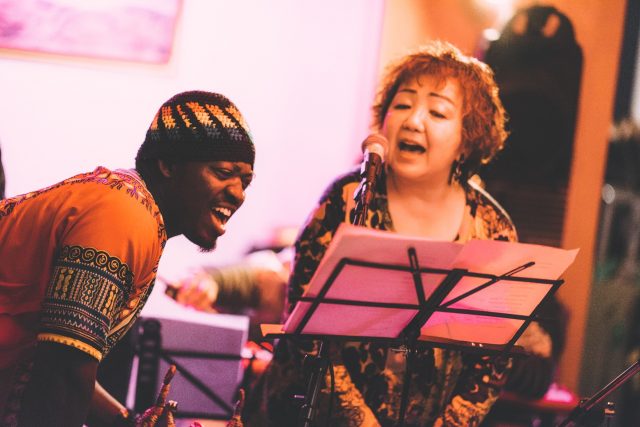
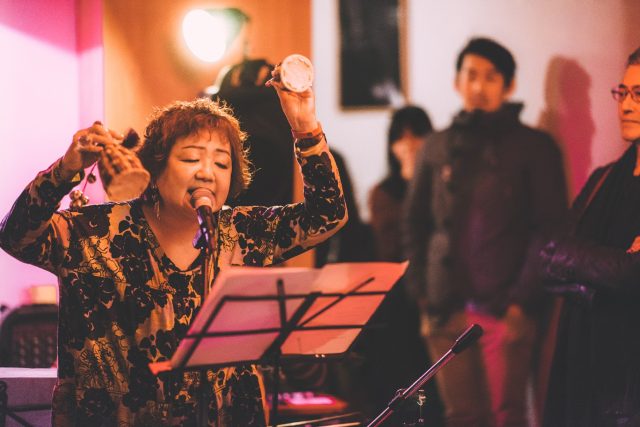
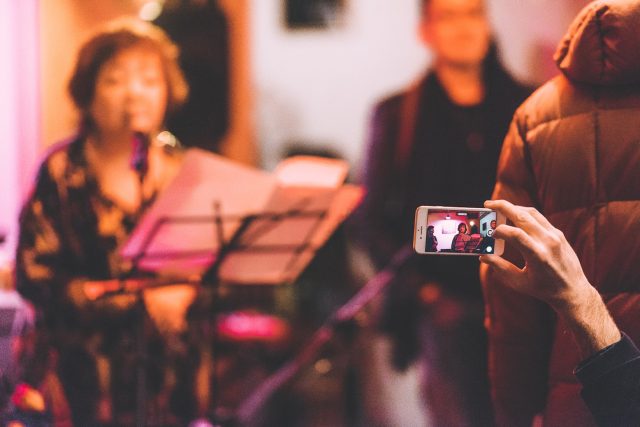
Photos of the reading by John Matthews
I read this poem with my YURICANE spoken-word band: Winchester Nii Tete (percussion), Kouzan Kikuchi (shakuhachi) and Hirokazu Natsuaki (cello), crossing borders so sounds, genres, cultures, people come together in a performance with no score but all soul.
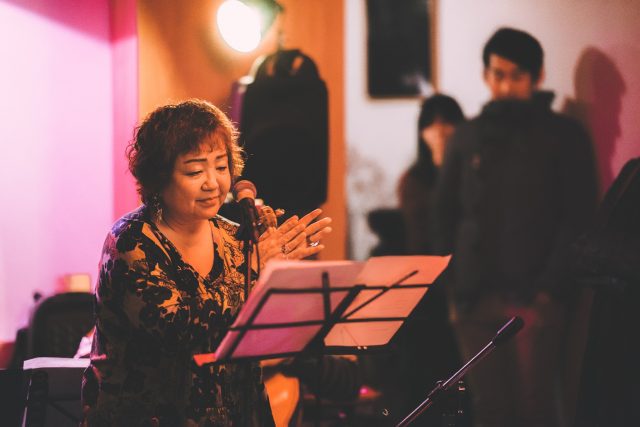
Motherhood poems are usually square or oppressive and so many women don’t like to write about motherhood. I chose pushing the stroller as a metaphor to depict motherhood in all its proper liberated glory. This happens to be in San Francisco because that is where I had my son and I pushed him around on strollers a lot. But it can be about any mom anywhere. The point of this poem is that it is location-specific and so it takes you on a journey, not only where the stroller went but also in our minds and our path of life like a movie.
We dedicate our performance to all mothers, including Mother Earth herself, and, of course, all the children.
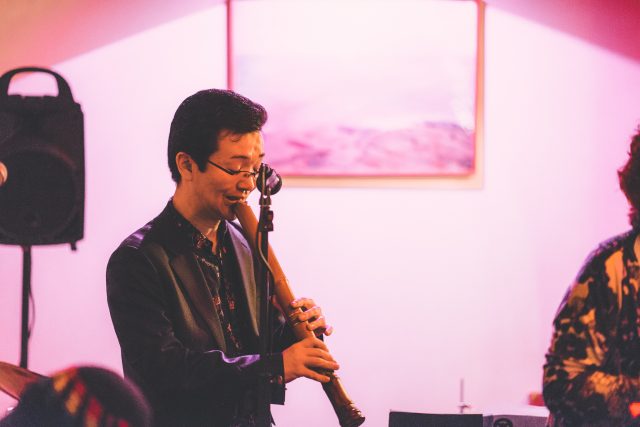
ode to the stroller
a poem by Yuri Kageyama
we zip weightless like silent angels
up and down San Francisco hills
running on the mother of all energy
greener than solar
rolling rolling rolling
with laughter
cream acid rock ‘n’ rolling
lightning dazzling wheels
gara-gara-gara-gara
teethers jangling dangling dancing
going mad on strangle-free rubbery ribbons
up and down the Avenues
J-town, Clement Street
Golden Gate Park
Museum of Modern Art
we are singing:
“Ouma no oyako wa nakayoshi koyoshi
itsudemo issho ni pokkuri pokkuri aruku”
perfume wind in our hair
springing over potholes
not even stopping just for breast feeds
connected as one through this magical machine
me pushing
you riding
the Lamborghini of strollers
the Gundam of strollers
the little train that could of strollers
up up up into the joyous clouds
zooming wheeeeee
down slurping slopes
around swervacious curves
we are one
yes, we are one
tied in the past with our
umbilical cord
and
even in death
in our dreams
This version of my reading was recorded at Jackson’s Garage in Tokyo, with Hirokazu Suyama Jackson on drums, Yuuichiro Ishii on guitar and Hiroshi Tokieda on bass.
The poem is about young motherhood some time back, but I wrote this poem recently.
The feelings remain the same, eternal:
KENNETH REXROTH ON MY MIND
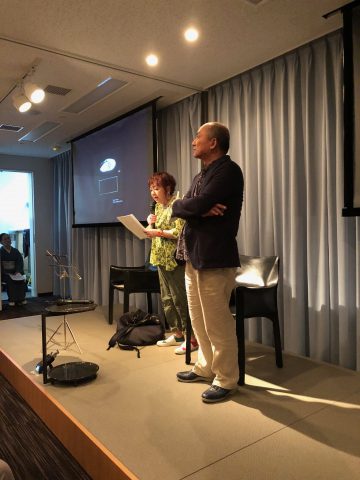
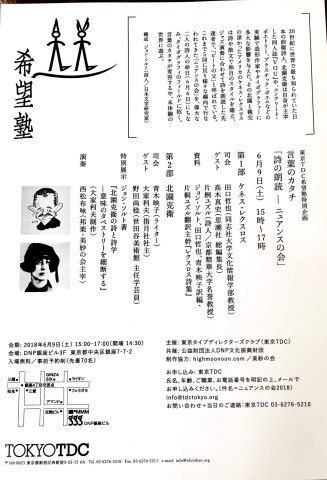
I took part in a poetry event in Tokyo’s Ginza to commemorate Kenneth Rexroth and Katsue Kitasono SAT June 9, 2018.
Avant-garde Beat Poetry Lives.
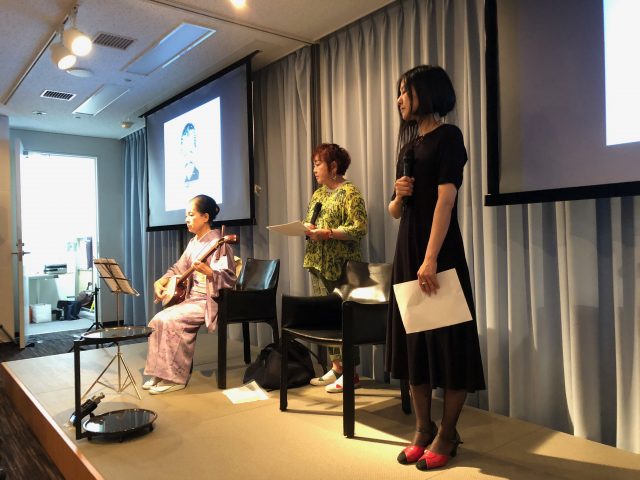
I read works from both poets, as a backdrop of slides of their visual works and portraits played, and one poem was a collaboration with shamisen.
Thanks to Professor John Solt for organizing the memorable experience and for including me.
I usually only read my own material.
And so this was quite a novel meaningful effort for me.
It was wonderful to see all the poets come out and read works by these two courageous poets who sought to explore worlds outside their limiting real borders.
I especially enjoyed a rendition of a Japanese translation of Rexroth’s writing about Kabuki.
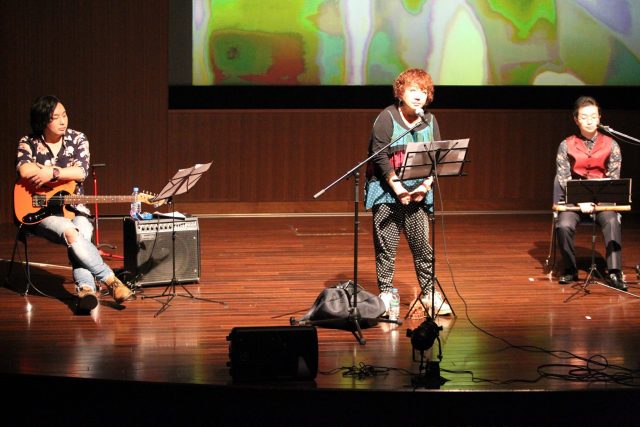
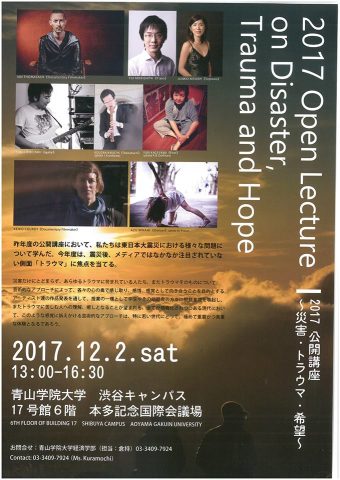
My poetry at Aoyama Gakuin University in Tokyo. With Yuuichiro Ishii guitar and Kouzan Kikuchi on shakuhachi. Film by Yoshiaki Tago. Photos by Junji Kurokawa. Thanks to Professor Marc Menish for having us. 2017 Open Lecture on Disaster, Trauma and Hope.
My Poetry at Aoyama Gakuin University in Tokyo. With Yuuichiro Ishii guitar and Kouzan Kikuchi on shakuhachi. Film by Yoshiaki Tago. Photos by Junji Kurokawa. Thanks to Professor Marc Menish for having us. 2017 Open Lecture on Disaster, Trauma and Hope.
We presented four poems that are excerpts from my NEWS FROM FUKUSHIMA: MEDITATION ON AN UNDER-REPORTED CATASTROPHE BY A POET:
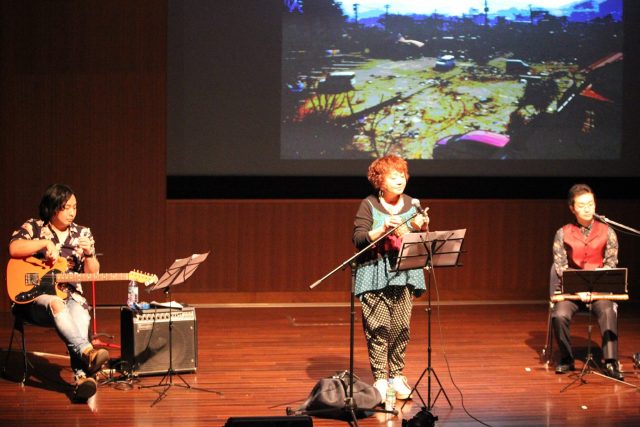
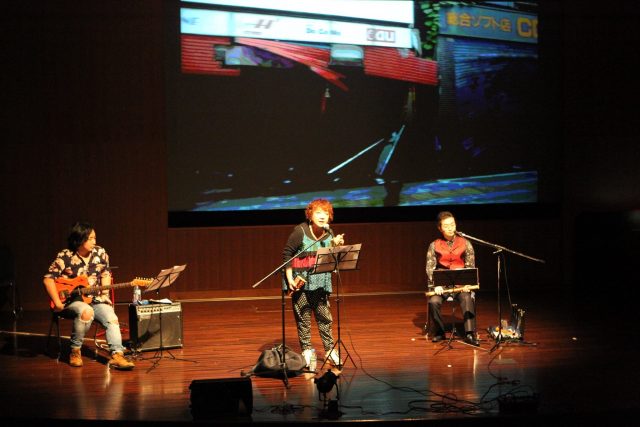
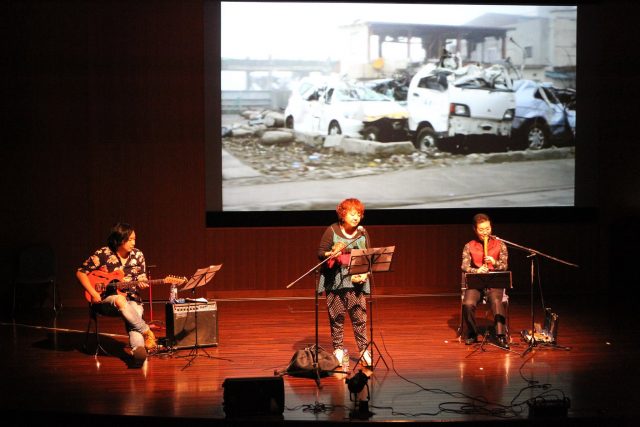
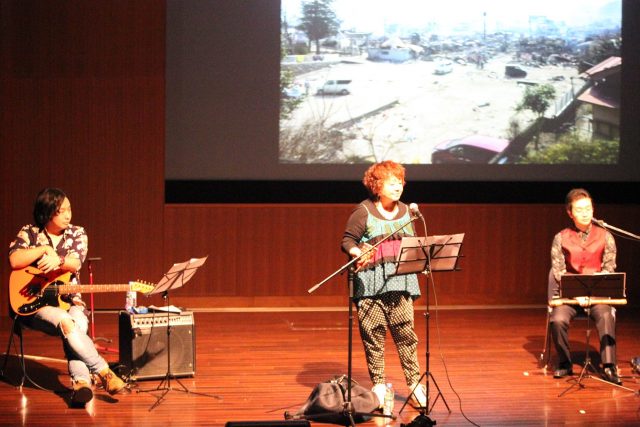
MYTHICAL MONSTER
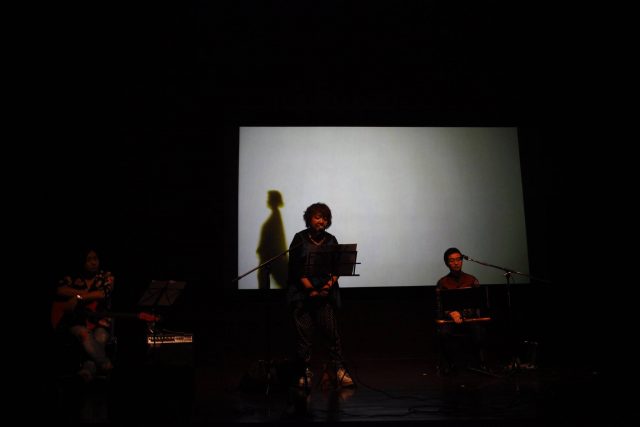
HIROSHIMA
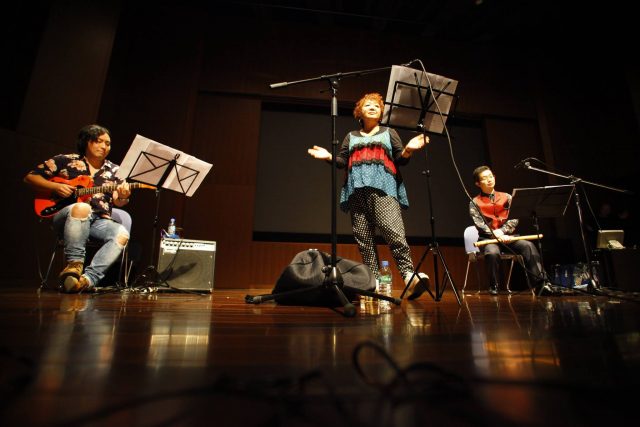
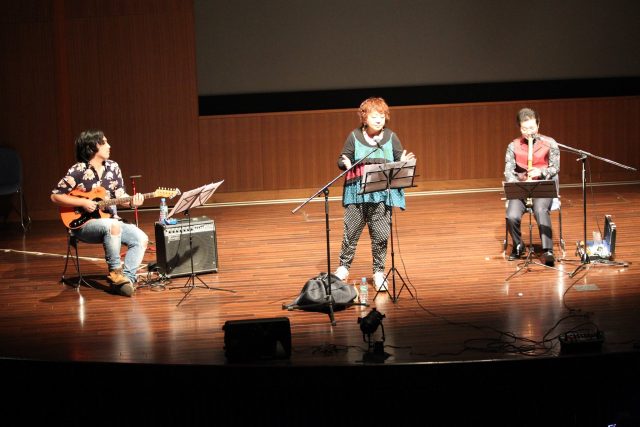
FUKUSHIMA
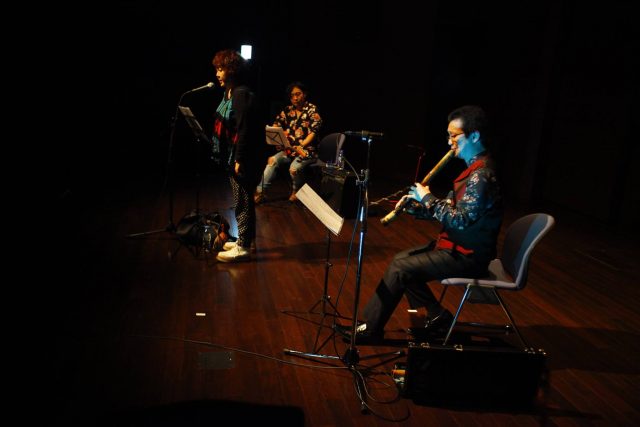
A MOTHER SPEAKS
Not wanting to say “Me too”
_ An essay by Yuri Kageyama
I have written about sexual abuse many times, as a poet and as a journalist, but I have not talked about my personal experience with sexual harassment.
I was involved in what has been credited as the first sexual harassment case in the U.S. to surface at an academic institution.
That was the University of California, Berkeley, where I was a student.
It was a highly publicized case, but I requested, as did the other victims, to stay anonymous.
I remember I got a call from a fellow student to take part in a campus protest over the case. I told her I was reluctant.
But I had to join forces, she said, breathless over the phone, because what some of the women were saying was amazing.
She read from a letter that was part of the case against the respected professor at the Department of Sociology, a Marxist with a progressive reputation.
The letter went something like this: “We came to the university to get an education, to realize our dreams and to develop as people. The behavior of this professor is unethical, sexist and unprofessional.”
“And so can’t you come to the protest?” she insists.
I keep saying, “No.” But she insists.
And so finally I have to say it.
“I wrote that letter,” I tell her. “And I don’t want to join.”
She falls silent on the other end. It is a painful, sad and numbing moment.
And this is the same way I feel today, decades later.
I respect all those who are saying, “me too.” If there is any redeeming factor to coming out, it is in the knowledge of the systematic pattern of abuse _ that we are not alone, that this is not an extraordinary happening but everyday.
It must be OK to be victims, if it is practically everybody.
But I still don’t feel the trust.
I don’t feel anything good will come of it. And it is not up to the victims to bring justice to an abuser or a harasser. That is not our job.
I did not start the process back then, although I did write that letter when asked, for the investigation.
I had gone earlier to one professor whom I trusted. He shrugged and told me to grow up. He mentioned that he himself had married his student.
But word on the problem professor’s antics gradually got out.
The case initially divided the department _ between those who were stunned someone in their ranks would be preying on students versus those who thought the whole case was a ditched up witch hunt.
And so they did what grown-ups do. They hired an outside objective lawyer and investigator, from Stanford University, I believe, to talk to all the alleged victims.
I remember I was called into her office. Yes, it was a woman.
So I told her what happened, hesitantly, nervously, replying to her questions.
It was another painful, sad and numbing moment.
He had called to say he wanted to discuss one of my papers and told me to come to a downtown Berkeley cafe. But when I showed up, a little flattered a professor would want to talk about my work, he had not even brought my paper.
We sat at a table, dimly lit, in the fancier part of Berkeley that I had never been to before. He told me he was interested in me because I was Asian, and he was not interested in loud American women.
He made a joke, something about: “I’m the man. I like to be on top.”
He complimented me on what I was wearing, a top that appeared to have Asian motifs. It was one of my favorite shirts, and I happened to have it on when I talked to the lawyer.
And so I told her that was what I had on. She asked, apparently a part of an investigator’s modus operandi to see how reliable my memory might be.
As it turns out, at least one woman was physically attacked in his car. There was another student who was happy about becoming his lover, and told everyone he had changed her life, whatever that meant.
This woman’s existence was as alienating and depressing as the existence of the woman who was attacked was alarming and horrifying.
It didn’t help for me to know the one who was attacked was a woman of color.
I was just afraid. I did not want to go into the department halls in case he would be there, and I would have to deal with him.
Maybe I would not be as afraid today. But I was young, and he was an older powerful male, who had my future in his control, and he had specifically said he wanted me to do something that I did not want.
I was already feeling violated, weak and objectified. It was an awkward, sickening feeling.
Unfortunately, he was there once, in the department mailroom. Although I tried to get away, he approached me and asked that I retract the letter I had written in the case against him.
He promised in a pleading tone that I would get an “A” if I would retract the letter.
My case was one of the “more damaging” against him, another professor had explained to me, because I had gotten all A’s in my work in his class, as well as my other classes, but after I refused his advances, he had given a B for my overall grade.
You don’t want to even weep. You just want the world to go away, and you don’t want to think about it. You don’t want to talk about it. You don’t want to even remember it.
I never finished my doctorate, settling for my Master’s.
The professor found another job, in a prestigious institution in Europe, and left on his own, still insisting on his innocence.
The lawyer doing the investigation recommended dismissal.
So we were vindicated, of sorts.
Years later, when a woman asked for my advice about a sexual harasser in her office, I told her just to stay away from him, never be alone with him, assuring her that I with my friends would be there for her physically, to protect her, if any situation arose she had to be with him. But I advised against making a public complaint.
So I don’t shout out, “me too.”
At least, I managed to write this today.
It’s strange and it’s not right I remember so much of it, the tiniest details _ the tone of the lawyer’s voice, the look in the professor’s eye, the dark orange glow of that table _ when it happened so many years ago.
People don’t understand you don’t have to be particularly beautiful or outstanding to be a victim.
It’s usually mundane, pathetic and devoid of glamour, neither Hollywood nor the Olympic team.
Some men just look around to what is available, vulnerable, close to them.
And I was there, a student, in that department.
I had a flowery Asian shirt on. That was all.
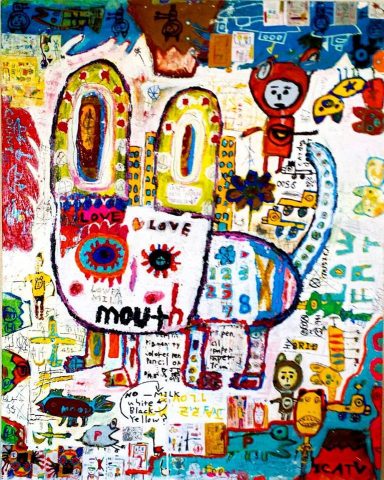
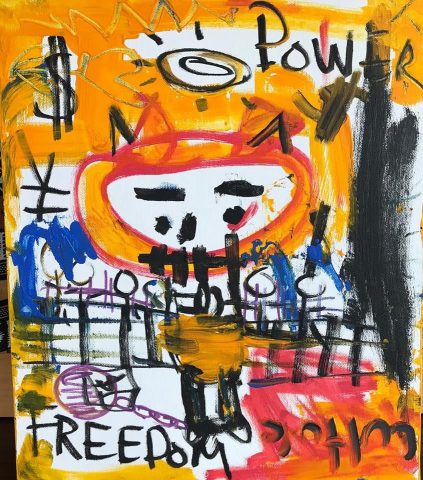
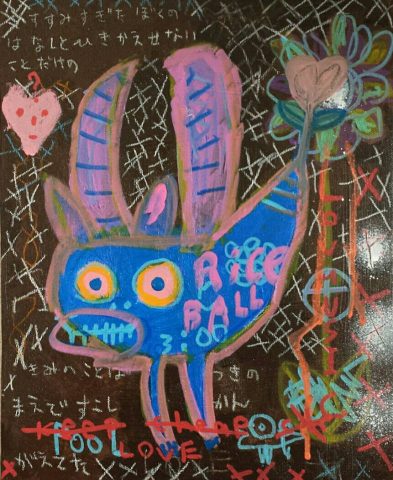
Artwork by Munenori Tamagawa
A COLLABORATION OF VISUAL ART, THE SPOKEN WORD AND MUSIC
THE VERY SPECIAL DAY
What: I read my poetry/story “The Very Special Day” while Munenori Tamagawa paints to guitar by Yuuichiro Ishii.
Where: Nagai Garou’s Tachikawa Gallery 1-25-24 Nishi Building 4 Fl Fujimicho Tachikawa, Tokyo TEL: 080‐9573‐5655
When: SAT Oct. 28, 2017 from 3 p.m. Reception party follows from 4:30 p.m ~ 6 p.m.
Who: Munenori Tamagawa, “the Basquiat of Japan,” has shown his work at the Seattle Art Fair, Tachikawa Art Brut and the streets of Tokyo, including Innokashira Park and the Shiodome Art Market.
Guitarist Yuuichiro Ishii, who studied recently at the Berklee College of Music on a prestigious scholarship, has performed with Fuyu, Mika Nakashima and Yusa, as well as my Yuricane spoken-word band.
Why: To celebrate the exhibition of Munenori Tamagawa’s recent works.
More What: Last year, Munenori Tamagawa and I created the children’s book THE VERY SPECIAL DAY, which brings together my story with his illustrations. More information on our evolving collaboration.
Artists make any day a very special day when we come together.
Video by Naomi Yoshida
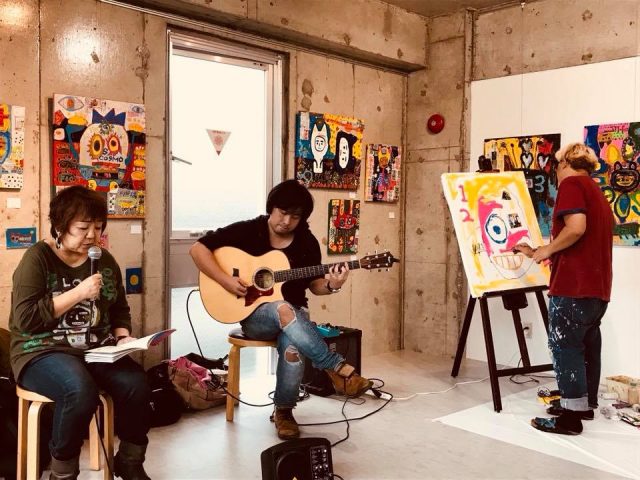
Photo by Seiko